

Key takeaways
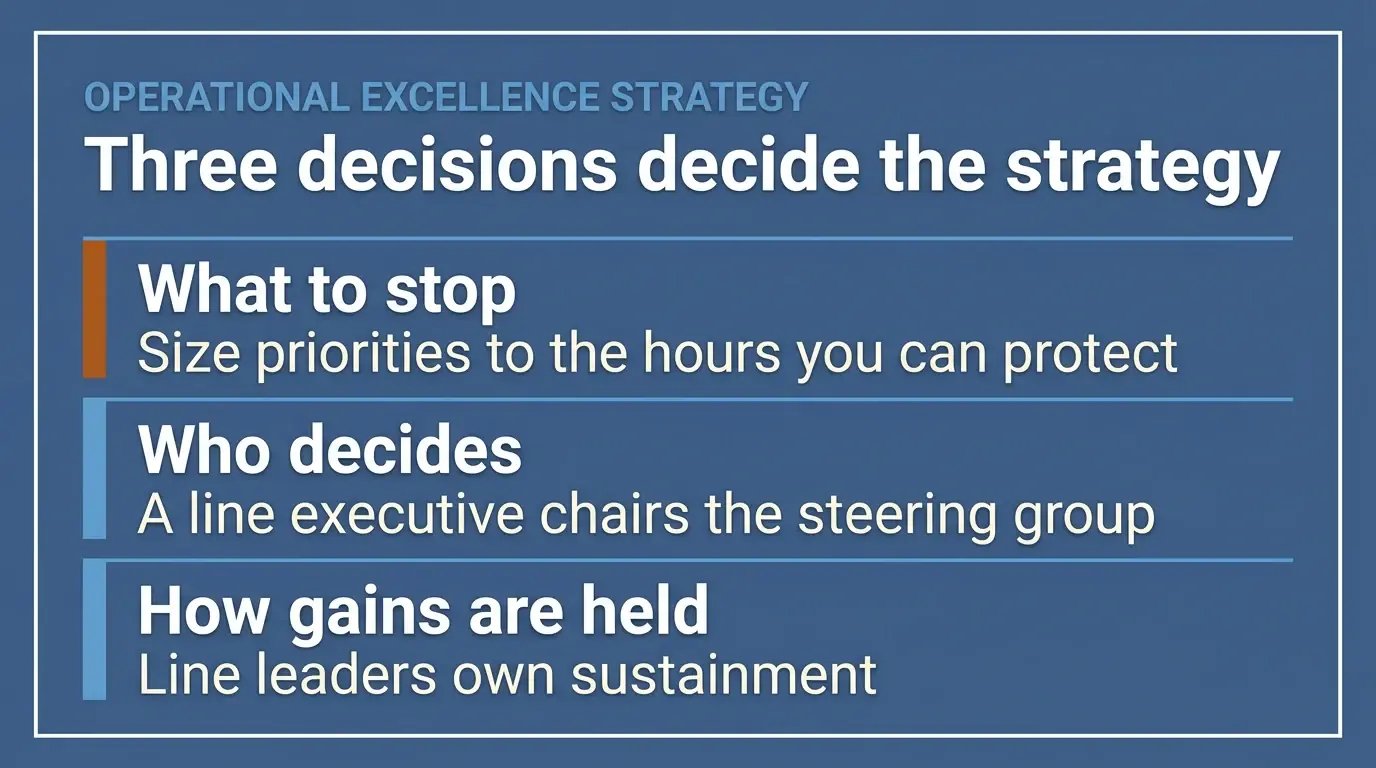
An operational excellence strategy for an existing program succeeds or fails on three decisions: what to stop, who decides, and how gains are held.
- Assess maturity site by site, since one program can span all three 2026 Baldrige maturity pathways.
- Size the priority list to the improvement hours you can protect. Every new priority should name the work it displaces.
- Give every improvement the same record, whatever the method: an owner, a linked objective, a status, and a validated impact.
- Set success criteria before work starts, and measure adoption alongside outcomes. PMI research links upfront success criteria to success rates nearly two times higher.
If your strategy funds more priorities than you have protected capacity, and no line leader owns sustainment, rewrite it before the next planning cycle.
An operational excellence strategy usually holds up through the first wave of results and starts to slip after that. New priorities keep arriving, nobody has clear authority to drop old ones, and people get spread thinner until early gains fade.
Leaders of established programs already have years of continuous improvement, Lean, Six Sigma, and Kaizen work behind them. The redesigned 2026 Baldrige Excellence Framework offers three maturity pathways because organizations start in different places. For definitions and pillars, see what operational excellence is. This guide covers the decisions.
What is an operational excellence strategy, and how is it different from a plan?
An operational excellence strategy is the set of choices that decides where improvement capacity goes, who controls it, and how results are kept. The plan lists the resulting work, and the roadmap puts it in order. Many documents titled "strategy" are plans in practice, with long initiative lists and nothing about what the organization will stop doing.
| Step | Decision it forces | Output | Where it usually breaks |
|---|---|---|---|
| 1. Goals | Which business outcomes matter most | A short list of objectives with baselines | Written as program activity counts |
| 2. Current state | Where each site actually starts | Maturity read by site and function | Scored by the team being scored |
| 3. Priorities | What the organization will stop | A capped portfolio | Nothing is dropped, so capacity splits |
| 4. Governance | Who decides, and how often | Review cadence and decision rights | Steering meetings that report and never decide |
| 5. Execution | How goals reach daily work | One shared record for all improvement work | Strategy stops at the director level |
| 6. Measurement | What counts as working | Success criteria set before work starts | Activity counts reported as results |
| 7. Sustainment | How gains are held | Line-owned routines and a searchable history | Program fades when the sponsor moves on |
Step 1: What should operational excellence goals actually say?
In a working operational excellence strategy, goals are few, written in business results, and each one has a baseline and a target date. "Cut order-to-ship lead time at three distribution centers from nine days to five" qualifies. "Run 40 kaizen events" is fine for the improvement team, but it measures effort, and executives fund results. Ask whether your CFO and COO could each explain why every objective matters.
Add one capability goal, and make it frontline participation rate. Event counts show how busy the improvement team is, while participation shows how much of the organization is involved and whether gains will hold.
Step 2: How do you assess your current state honestly?
Score the management system by site and function, checked by someone outside each area. One enterprise-wide rating can hide that one plant runs tiered huddles with escalation while another reviews metrics once a month in a conference room.
The 2026 Baldrige framework describes three pathways. Establishing is about clarifying how work gets done and which processes matter most. Developing builds consistency and accountability, with data in regular use. Maturing connects leadership, strategy, operations, and results into a system that learns.
| Baldrige pathway | What it builds | Where the strategy should start |
|---|---|---|
| Establishing | Clarity on how work is performed and which processes matter most | Map critical processes and agree on what to measure |
| Developing | Consistency, accountability, and regular use of data | Install the review cadence and decision rights in Step 4 |
| Maturing | Leadership, strategy, operations, and results connected | Share learning across sites and guard against drift |
Next, count the improvements already in flight: how many are open, how many have not moved in the last quarter, and how many link to any objective. If that takes days of pulling from spreadsheets, SharePoint, and Power BI, record that effort as a finding.
Step 3: How many priorities can the organization absorb?
An organization can take on only as many priorities as its protected improvement hours can fund, usually fewer than leadership hopes. Fund priorities until the hours run out, then stop. Strategy deployment keeps breakthrough objectives to a handful for the same reason.
Taking work off the list is where leadership teams get stuck. A 2025 Harvard Business Review article on project overload argues that organizations know they run too many projects but rarely kill any, and that stopping a project should count as a leadership decision in its own right.
A simple rule helps in an operational excellence plan. Any new priority has to name the work it replaces, or it waits.
Step 4: Who governs the operational excellence plan?
A small steering group chaired by a line executive, not the head of improvement, should govern the plan. With the improvement leader in the chair, the meeting turns into the program reporting on itself, and nobody moves resources because the chair does not control them.
The operating cadence
A common structure uses three tiers: teams meet daily at a huddle board, departments meet weekly, and the steering group reviews the portfolio monthly. Each tier reviews its metrics, active improvements, and open problems.
Set each tier's escalation window in hours, so a problem the team cannot solve moves up automatically instead of waiting for the monthly review.
Decision rights and ownership
Every objective needs one named owner who has the authority to move resources. The steering group decides what starts, what stops, and where capacity goes. Judge the group by how often it makes those calls, and have finance validate benefit claims before anyone reports them.
Step 5: How does operational excellence implementation reach the front line?
Implementation reaches the front line when objectives are negotiated down each level and every team logs improvements in the same record. An operational excellence strategy that stops at the director level produces aligned slide decks and unaligned daily work.
The established method is cascading goals through strategy deployment, or Hoshin Kanri, with targets negotiated level by level through catchball and tracked on an X-Matrix. To check the cascade, see what share of this quarter's frontline improvements are tagged to a strategic objective.
Teams can use any method that fits, as long as the record matches. A Six Sigma project, an A3, a Kaizen event, and a frontline idea should all carry the same fields: owner, linked objective, status, and validated impact. Leadership can then see the whole portfolio. Teams using KaiNexus follow through on over 75% of their improvements.
Step 6: How do you measure whether an operational excellence strategy is working?
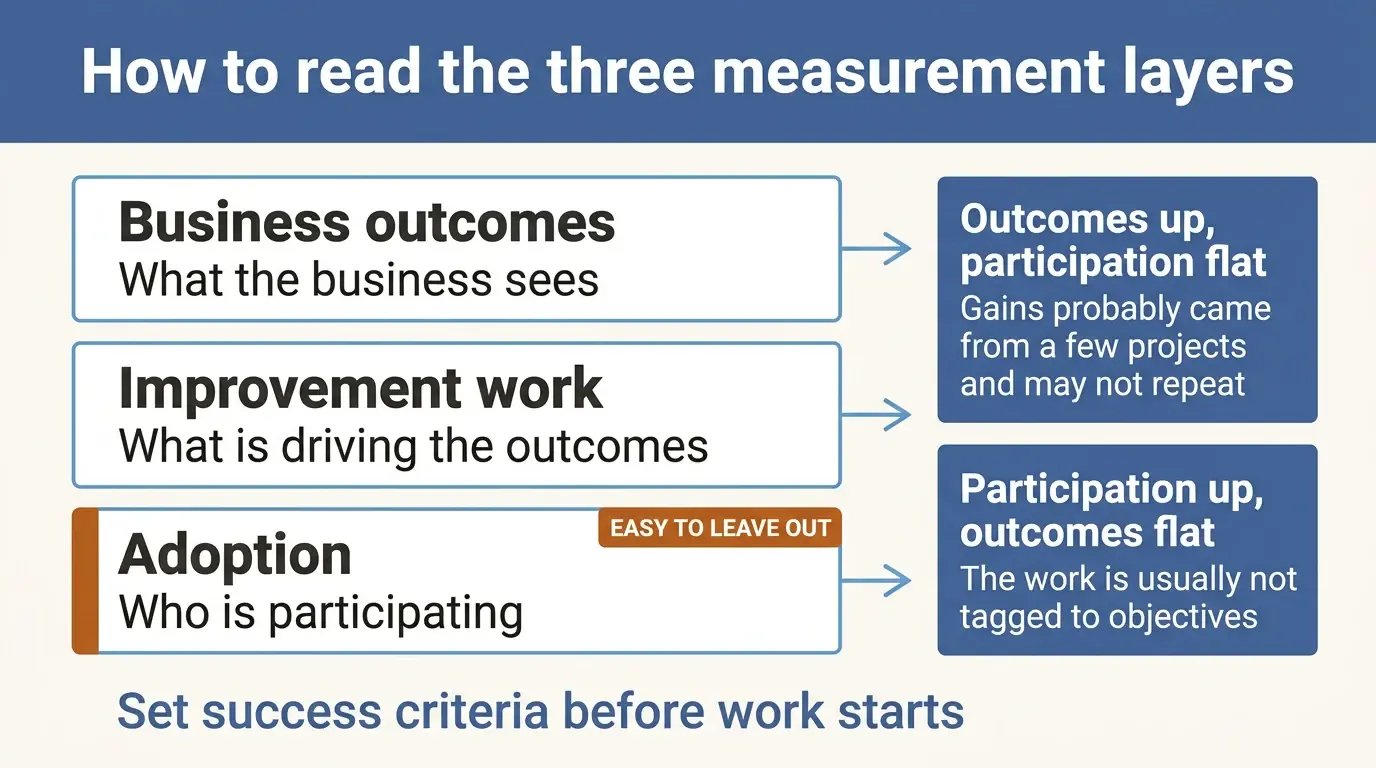
Set success criteria before work starts, then track business outcomes, the improvement work behind them, and adoption. PMI's 2025 Pulse of the Profession report cites PMI research finding that projects with upfront success criteria and a working measurement system succeed nearly twice as often.
Adoption is the easiest of the three to skip, and it explains the other two. Better outcomes with flat participation usually mean a few projects carried the gains. Rising participation with flat outcomes usually means the work is not tagged to objectives. For the full KPI set, see Measuring Operational Excellence: Key Metrics & KPIs for Continuous Improvement.
Report hard savings and cost avoidance separately, and look past the headline wins. Across the KaiNexus customer base, 28% of improvements carry direct financial impact, the average improvement is worth roughly $15,000, and about 1 in 100 exceeds $100,000. If the roadmap celebrates only six-figure wins, frontline teams submit fewer small ideas, and those small ideas are where the rare large wins come from.
Step 7: What keeps the gains from eroding?
Line leaders own sustainment in a durable operational excellence strategy, and the improvement record has to outlast the people who built it. The Shingo Institute's Shingo Model points out that most systems are designed to hit a business result with little thought for the resulting behavior. The Shingo Challenge asks for at least three years of sustained improvement, a reasonable yardstick for proving gains have held.
In practice, update standard work the same day an improvement is adopted. Audit leader standard work on a set schedule, and use daily management and huddles to keep metrics in front of the people who can move them. Line leaders own all three.
The improvement record can feel like paperwork, but years of documented problems and countermeasures give the next team something to search before starting over. For the leadership behaviors involved, see Building Operational Excellence Culture | KaiNexus.
Why do operational excellence strategies stall?
Operational excellence strategies tend to stall in recognizable ways, and each pattern shows up early enough to catch in a quarterly review.
- The priority list only grows. New objectives show up every quarter and none come off. The displacement rule from Step 3 stops the buildup.
- Steering meetings report instead of decide. If the monthly meeting is all green status slides, the group has stopped governing. Require at least one start, stop, or reallocation decision per meeting.
- The strategy stops at the director level. Directors recite the objectives, but frontline teams cannot name one. Ask five people which objective their current work supports.
- Activity gets reported as impact. Event and belt counts rise while outcomes stay flat. Report validated outcomes and participation next to the counts.
- Sustainment belongs to the improvement team. Gains fade when the sponsor moves on and nobody on the line has inherited the routines. Move ownership to line leaders before the first wave closes.
Operational excellence strategy FAQ
Once the strategy is on paper, the questions turn to sequencing, existing improvement work, timing, and scale. Most answers depend on whether everything runs through one review cadence and one shared record.
What is the difference between an operational excellence strategy and an operational excellence roadmap?
The strategy sets which outcomes matter, what stops, who governs, and how gains are held. The roadmap sequences the resulting work. Without a strategy behind it, a roadmap cannot say what gets dropped when capacity runs short.
How do you fold an existing CI program into an operational excellence strategy?
Keep the methods and consolidate the record. Tag every open improvement to an objective or close it, then run everything through one review cadence. Continuous improvement is a core part of how the strategy gets executed, and relaunching it under a new name throws away history that later work depends on.
How long does operational excellence implementation take?
Early results can appear quickly. A sustained operating system takes years, and the Shingo Challenge requires multi-year evidence that gains have held. Plan in annual cycles with quarterly checkpoints.
How should the strategy handle multiple sites?
Assess each site's maturity separately, standardize the review cadence and the improvement record, and let sites choose methods that fit their problems. The hard part is seeing every site's work without building reports by hand. For scaling a program across the enterprise, see How To Achieve Operational Excellence at the Enterprise Level.
Run your operational excellence strategy in one system
An operational excellence strategy is much easier to run when every objective, owner, improvement, and validated result lives in one shared record. In most organizations that information sits across spreadsheets, SharePoint, Power BI, and slide decks, stitched together by hand before each review. KaiNexus gives organizations that system, from frontline ideas and daily huddles through problem-solving, strategy deployment, and impact reporting. Get a demo to see how it would run your program.



Add a Comment