
Vic Minhas, Sr. Director of Continuous Improvement at Trinity Industries, shared his team's improvement journey at KaiNexicon 2022. What started with a dusty idea board and four submissions in a year became a company-wide system capturing hundreds of ideas across every level of the organization.
Since 2015, Vic Minhas has been leading Trinity Industries' continuous improvement (CI) journey towards excellence. In this role, he is focused on using an intrinsic approach to develop a long-lasting CI culture for Trinity.
Read the re-cap of Vic’s presentation below, or watch the recorded presentation:
It started at Costco
Trinity's CI journey took a turn during an AME (Association for Manufacturing Excellence) conference in San Diego. The team visited a Costco facility and noticed something in the middle of the shop floor: a simple idea board labeled "Improvements Through Employee Engagement." No A3s. No formal methodology. Just ideas from employees focused on safety, quality, and waste reduction.
Vic brought the concept home and built a similar board for Trinity's plants. The team was excited. The employees were not. After 12 months, the board had collected exactly four ideas -- and a layer of dust.
"You go look at the board, you touch it, there's dust over there, and you feel sad and the energy goes away," Vic recalled.
He shelved the idea entirely.
What changed: moving from a board to a system
That's when Trinity partnered with KaiNexus. The shift wasn't just physical-to-digital. It was structural. A board on a wall is passive -- employees have to seek it out, and there's no feedback loop once an idea is submitted. KaiNexus gave Trinity a system where ideas could be captured from a phone, routed to the right person, tracked through implementation, and made visible to the person who submitted them.
The mobile app turned out to be critical. Vic's point was simple: people don't get their best ideas sitting at a computer. They get them on the floor, during a walk, after exercise. The app let anyone capture an idea the moment it occurred -- snap a photo, add a note, tag it, submit it.
Within six months of launching KaiNexus, Trinity went from 4 ideas to 653.
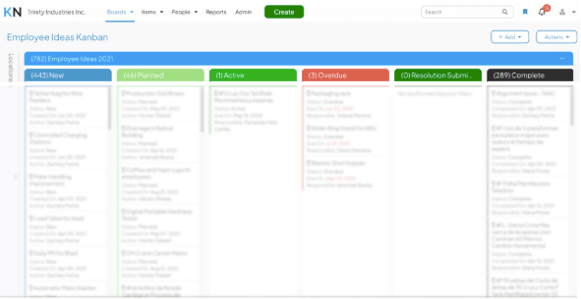
All Shop Floor employee ideas can be found on a Kanban Board, as a way to see the status of your idea and who is assigned to it. This way after an employee submits an idea, this Kanban Board employees the opportunity to visually see their Idea through each stage.
Three levels, three different uses
Vic described how Trinity configured KaiNexus differently for each level of the organization -- not as a one-size-fits-all tool, but matched to how each group actually works.
Shop floor employees submit ideas through the app. Every idea lands on a kanban board where the submitter can see its status: who's assigned to it, what stage it's in, whether it's active or complete. That visibility is what the old physical board couldn't provide. When people can see that their idea is being worked on -- not sitting in a pile -- they keep submitting.
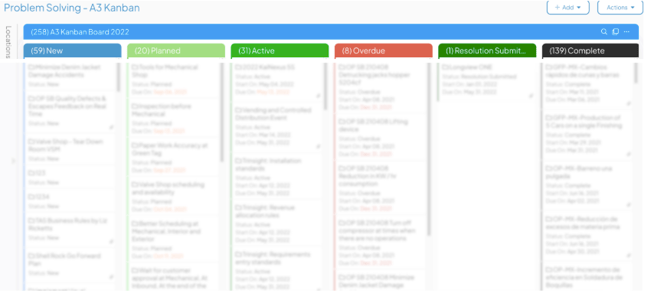
Frontline leaders (plant managers, supervisors) use KaiNexus primarily for A3 problem-solving. Trinity runs roughly 100 kaizen events per year, and before KaiNexus, the documentation from those events ended up in the recycling bin. Five hundred kaizens over five years, gone. "What happens when it goes in the recycle bin? We reinvent the wheel," Vic said. Now every A3 is searchable -- if a new site needs to improve a process, they can search the database and find what's already been learned. Vic described it as building a "Google search" for Trinity's improvement knowledge.
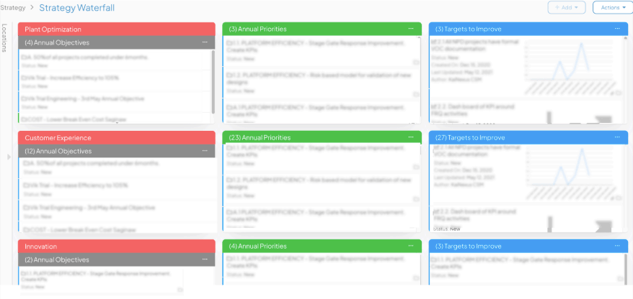
Executives use KaiNexus for strategy deployment. Trinity had been using a traditional X-matrix, but the format frustrated senior leaders. Reading an X-matrix means scanning horizontally and vertically across a dense spreadsheet -- not ideal for a CEO review. Working with the KaiNexus team, Vic's group built a strategy waterfall view that presents the same information (objectives, priorities, metrics) in a format executives actually want to read. The connection between shop floor ideas, frontline A3 projects, and strategic objectives became visible in one system.
Why it worked
The 4-to-653 number is striking, but the deeper story is about what made that jump possible. Three things stand out from Vic's experience:
The feedback loop closed. On the old board, ideas disappeared. In KaiNexus, every idea has a status, an owner, and a visible path forward. That transparency is what sustains participation.
The tool matched how people actually work. Mobile capture for the shop floor. A3 templates for frontline leaders. Strategy views for executives. Forcing everyone into the same interface would have created friction. Configuring the system for each audience removed it.
Improvement knowledge stopped being disposable. Five years of kaizen documentation had been lost before KaiNexus. Now it's searchable, reusable, and available to every facility. New sites don't start from zero.
Vic's advice to organizations considering a platform like KaiNexus was blunt:
"Be an early adopter. I don't see a reason why we will be using spreadsheets or systems that really don't work."
His formula for continuous improvement, after a career that includes a Master Black Belt and training at five different programs, came down to something simpler than any methodology: build a culture where people bring their ideas, and build the system to act on them.
See how KaiNexus captures and tracks improvement across every level of your organization. See KaiNexus in action →



.svg)



Add a Comment