

Key takeaways
Enterprise business transformation tends to fail at the seams between business units, and the most dependable fix is to run it through the operational excellence program you already have.
- Harvard Business Review research puts the share of transformations that produce lasting results at 12%, and that figure hasn't moved in 20 years.
- A transformation office set up beside the OpEx program leaves frontline managers answering to 2 priority lists.
- Governance works when each of 3 tiers owns its own decisions and the executive team tracks 15 to 20 initiatives serving a handful of breakthrough objectives.
- Set definitions and method centrally, and let each business unit decide how to apply them.
If your transformation office can't say what it stopped last quarter, make that the first question at the next steering review.
Most enterprise transformations get launched beside the operational excellence program instead of through it. A transformation office shows up with its own priority list and reporting cadence, while the A3s, huddles, and trained problem solvers keep running on a separate track. Enterprise business transformation works better when it runs through that existing program. The usual approach has a poor record. Research published in Harvard Business Review found that only 12% of transformations produce lasting results, and that share hasn't changed in 20 years.
This guide is for CI, OpEx, quality, and transformation leaders at enterprises that already run an improvement program. The business transformation overview covers what business transformation is and why companies take it on. At enterprise scale, the hard problems are governance, executive alignment, and rollout across business units.
What makes enterprise business transformation different from other change?
Enterprise business transformation has to hold across business units that each have their own leaders, budgets, metrics, and history, so coordination becomes most of the work. One plant can transform with a single leadership team. An enterprise can't, because nobody sees all of the work at once.
Much of the effort goes into keeping dozens of initiatives from pulling on the same engineers, getting every region to mean the same thing by "savings," and settling what happens when 2 units want opposite things. Those governance problems are why a plan that worked at the first site often stalls by the fifth.
Enterprise-wide transformation covers organizational and strategic change, such as structure, decision rights, priorities, and ways of working. Technology is one workstream inside it, and digital roadmaps and digital governance are their own discipline.
Should transformation run through your existing operational excellence program?
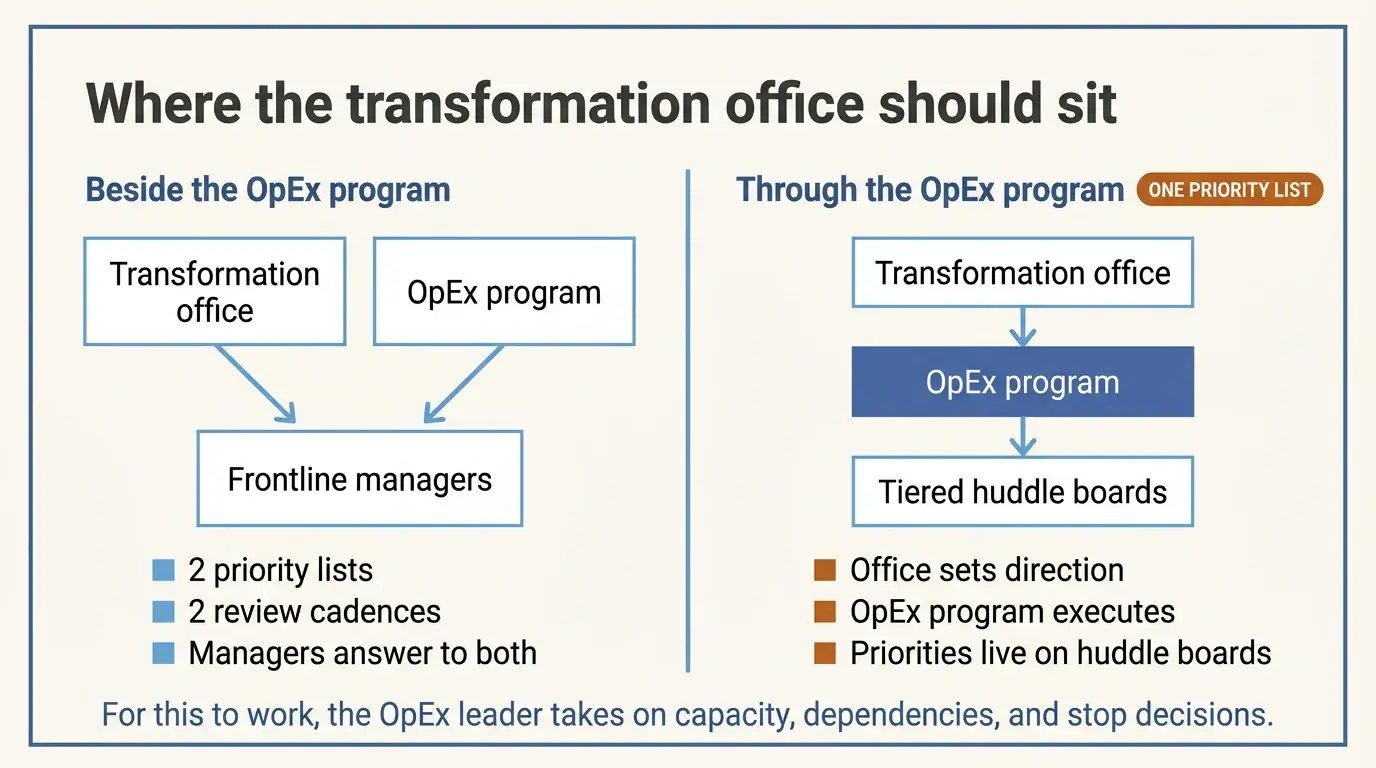
In most enterprises it should. The transformation office sets direction and coordinates the portfolio, and the OpEx program does the executing. A parallel structure leaves the enterprise with 2 priority lists and 2 review cadences, and frontline managers end up answering to both.
A separate office is faster to stand up and reports straight to the CEO, and in some companies OpEx is seen as a cost-cutting function with little say in strategy. Those reasons argue for giving the program more standing, and HBR's research backs that up. In that research, the transformations that lasted were built into the operating rhythm and driven from the middle of the organization outward.
An established OpEx program already has that rhythm. People are trained in a problem-solving method, daily issues surface on huddle boards, and escalation paths exist. Teams using KaiNexus follow through on over 75% of their improvements. To carry a transformation, the OpEx leader has to take on portfolio work, including capacity, dependencies, and stop decisions.
How should transformation governance be structured?
Transformation governance works best in tiers, with each tier making a different set of decisions on its own schedule. When executives hold all of it, they miss what's happening in the units. When the units hold all of it, you get a dozen local transformations that happen to share a name.
| Tier | What it decides | Typical cadence |
|---|---|---|
| Enterprise steering group | The priority list, funding shifts, and what stops | Monthly or quarterly |
| Transformation office | Dependencies, resource conflicts, and escalations | Weekly |
| Business unit leads | Local plans, sequencing, and how practices are adapted | Weekly to daily |
The enterprise steering group
The steering group is the CEO plus the leaders who control budget and headcount. It sets the priority list, moves funding, and makes the stop decisions nobody further down can make. If its monthly or quarterly meetings are mostly status slides, the tier below is falling short.
The transformation office
The transformation office handles anything that crosses unit lines. It's best led by a senior leader with direct access to the steering group, often the OpEx leader. Week to week, the office keeps the portfolio current, catches it when 2 initiatives need the same engineers in the same quarter, and escalates conflicts with a recommendation attached. It shouldn't run projects itself, because units that wait on the office for local decisions slow everything down.
Business unit leads
Business unit leads translate enterprise priorities into local plans, sequence the work, and adapt practices to their operation. They're also the first to know which parts of the plan don't hold up in their unit. Weekly and daily tiered huddles carry that information up, since a problem a team can't solve moves to the next tier on a set timeline.
Written decision rights and escalation on a clock keep the tiers working. Every recurring decision has a named owner, and an issue stuck at the unit level moves up after a set period instead of sitting until the next quarterly review.
How do executives stay aligned after the launch?
Executives stay aligned when they share one short priority list, review it on a fixed schedule, and own each priority jointly. Agreement at launch is easy, and it erodes as each leader goes back to a function with its own targets.
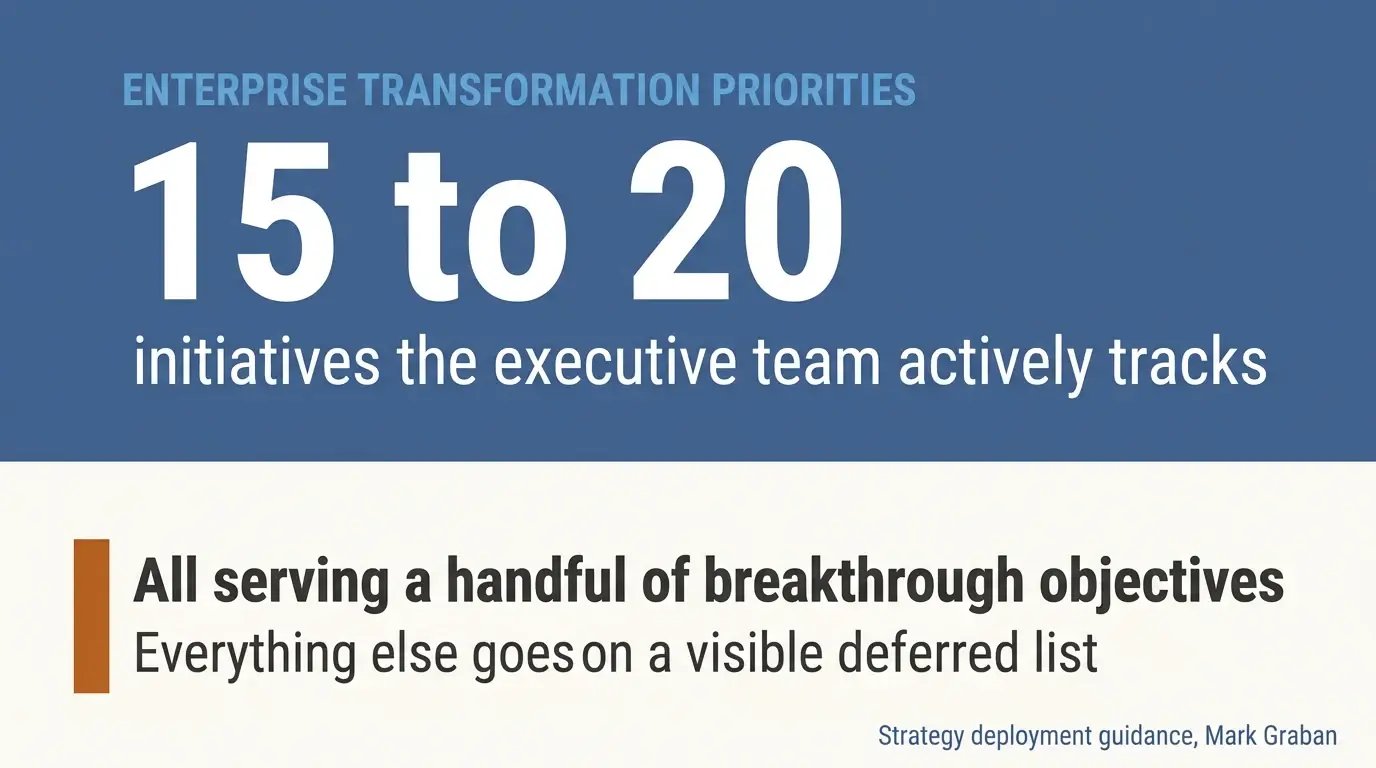
The drift shows up lower in the organization first. Ask the managers executing the plan to list the enterprise's priorities, and you'll often get several different lists. Part of the problem is length. Lean author Mark Graban recalls John Toussaint showing an organization with 222 top-priority projects, and Graban argues the real question is which 15 to 20 initiatives have to get done this year. Those initiatives serve a handful of breakthrough objectives, which keeps the top of the list short.
Hoshin kanri gives the list a structure. An X-matrix ties breakthrough objectives to annual priorities, initiatives, and metrics on a single page. Through catchball, business unit leaders push back with what they can deliver before anything is locked in. Each review checks whether the team did what it said and whether the result matched expectations. Those are the core mechanics of the discipline of strategy deployment.
What operating model changes does enterprise transformation require?
Most enterprise transformations change who makes which decisions, how work moves between units, and what the center standardizes. The operating model determines whether the organization can follow the strategy without every cross-unit question ending up on the CEO's desk.
Decision rights usually change first. Some move down to the units so problems get fixed where they happen, and others move up to the center so 5 regions stop building 5 versions of the same process. An enterprise transformation strategy also runs several workstreams in parallel: structure and roles, processes, performance management, capability building, and technology. Technology has its own playbook for roadmaps, platforms, and digital governance, which How Top Organizations Run Enterprise Digital Transformation covers. Governance sequences the workstreams so a new system doesn't go live before the roles and processes it depends on exist.
How do you coordinate a portfolio of transformation initiatives?
Run the transformation as one portfolio that includes frontline improvement work, ties every initiative to a priority, checks capacity across units, and keeps a visible list of what's been deferred. Most portfolios track only the major initiatives and miss much of the change actually happening.
Start the inventory with unit-level initiatives nobody at the center approved, where the unexpected load usually sits. Deselection is the decision leaders avoid most. Graban describes how ThedaCare handled it, with a section of wall in the executive room for deferred initiatives so they stayed visible without quietly coming back. Judge the portfolio on value as well as activity. PMI's research now defines project success as delivered value worth the effort and expense.
Across the KaiNexus customer base, 28% of improvements carry direct financial impact, the average improvement is worth roughly $15,000, and about 1 in 100 exceeds $100,000. That's why the measures in 28 Metrics for CEOs to Measure Transformation Success pair financial results with continuous improvement measures.
Why does change management break down across business units?
Change management tends to break down because it runs through middle managers, and an enterprise transformation adds to their load without taking anything off it. They explain the change to their teams, absorb the pushback, and keep daily operations on track at the same time.
Gallup's latest global workplace research found manager engagement fell from 27% to 22% between 2024 and 2025. An enterprise business transformation that piles a steering meeting, a status report, and a training series on top of the huddle schedule leans hardest on the people with the least time.
Put transformation priorities on the tiered daily management and huddles boards, where supervisors already check safety and quality. Then measure adoption by whether frontline improvements are tagged to enterprise priorities, not by who attended training.
How do you scale enterprise business transformation across business units?
Scale by setting definitions and method at the center and letting each business unit adapt the practices to its operation. Copying one site's playbook everywhere ignores real differences between units, and letting each unit invent its own approach leaves nothing to compare.
| Element | Set by the center | Adapted by the unit |
|---|---|---|
| Priorities | The enterprise priority list | Local initiatives that serve it |
| Measures | KPI definitions | Local leading indicators |
| Method | Problem-solving and review approach | Pace, sequencing, and examples |
| Governance | Escalation paths and cadence | Local meeting rhythms |
The center owns whatever the steering group compares across units, which covers priorities, KPI definitions, the problem-solving method, and escalation paths. Initiatives, local leading indicators, pacing, and meeting rhythms depend on local conditions, so each unit decides those. These practices keep enterprise-wide transformation consistent as it rolls out:
- Pilot in a representative unit. The easiest unit makes the pilot look good and teaches you the least. Choose one with typical constraints.
- Standardize definitions before dashboards. If plants define "on time" or "hard savings" differently, a shared dashboard compares numbers that don't match. Agree on the definitions first.
- Name a local owner in every unit. Rollouts stall when a unit leader absorbs the work on top of a full-time job. A named owner with protected time turns the central plan into local practice.
- Rotate people between units. A template reaches every site in an afternoon but can't carry the judgment calls behind it. Moving people from early units into later ones spreads that judgment.
- Make rollout pace a governance decision. The steering group approves each new wave once the current one shows results, instead of following a fixed calendar.
Frequently asked questions about enterprise transformation
Most questions about enterprise transformation come back to who decides, how much the enterprise takes on at once, and how progress gets judged across units. Tiered governance, a short priority list, and shared KPI definitions answer those in turn.
What is the difference between enterprise transformation and business transformation?
Business transformation is a deliberate, organization-wide change to how a company creates and delivers value to customers. Enterprise business transformation is the same kind of change carried out across multiple business units, sites, or regions at once. Coordination is the added difficulty, so governance and portfolio management carry far more weight.
How is enterprise transformation different from enterprise digital transformation?
Enterprise transformation changes structure, decision rights, priorities, and ways of working across the organization. Enterprise digital transformation deals with the technology side, including digital roadmaps, platforms, and digital governance. Digital work usually runs as one workstream inside the broader transformation.
How many priorities should an enterprise transformation carry?
Most enterprises should focus on a handful of breakthrough objectives, served by 15 to 20 initiatives the executive team actively tracks, and keep everything else on a visible deferred list. The 15 to 20 figure comes from Mark Graban's strategy deployment guidance, and it's far fewer initiatives than most enterprises run. Past that point, initiatives compete for the same people and few finish.
How do you know if transformation governance is working?
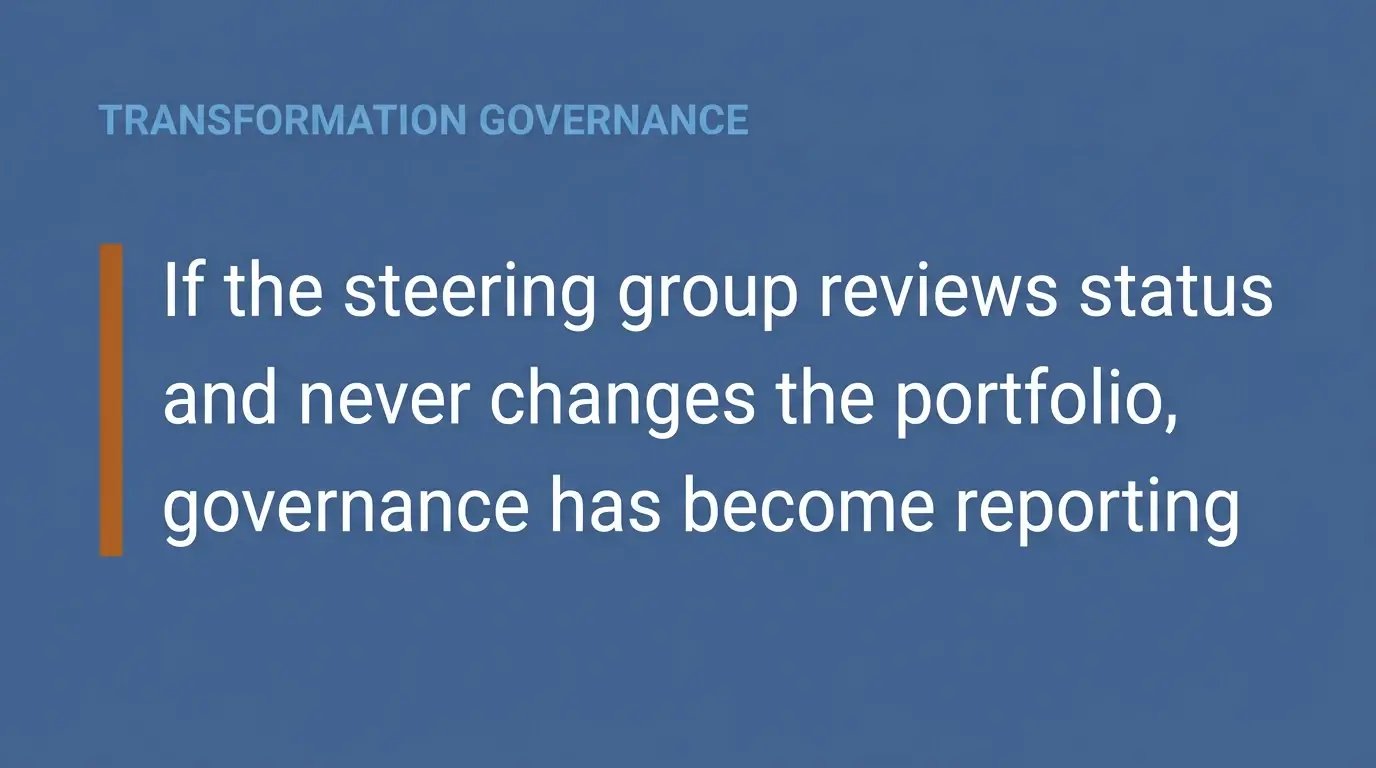
Governance is working when stop decisions actually get made and escalations get resolved within an agreed window. Business unit leaders should also be able to connect their local initiatives to the enterprise priority list. If the steering group reviews status and never changes the portfolio, governance has become reporting.
How long does an enterprise business transformation take?
Plan on it having no finish line. HBR's research found that the transformations with lasting results treated transformation as a continuous process instead of a program with an end date. That means governance built to last for years, with the priority list refreshed at least once a year through strategy deployment.
Run enterprise transformation through one operating system
Enterprise business transformation holds together when the priority list, the portfolio, frontline improvement, and the measures live in one place every tier can see. KaiNexus is the operating system for operational excellence and business transformation, bringing strategy deployment, improvement work, and daily management together across every unit. Get a Demo to see how it supports transformation governance at enterprise scale.



Add a Comment