

Key takeaways
Business transformation fails most often at the handoff from decision to daily practice, and the type of transformation you choose decides where that handoff sits.
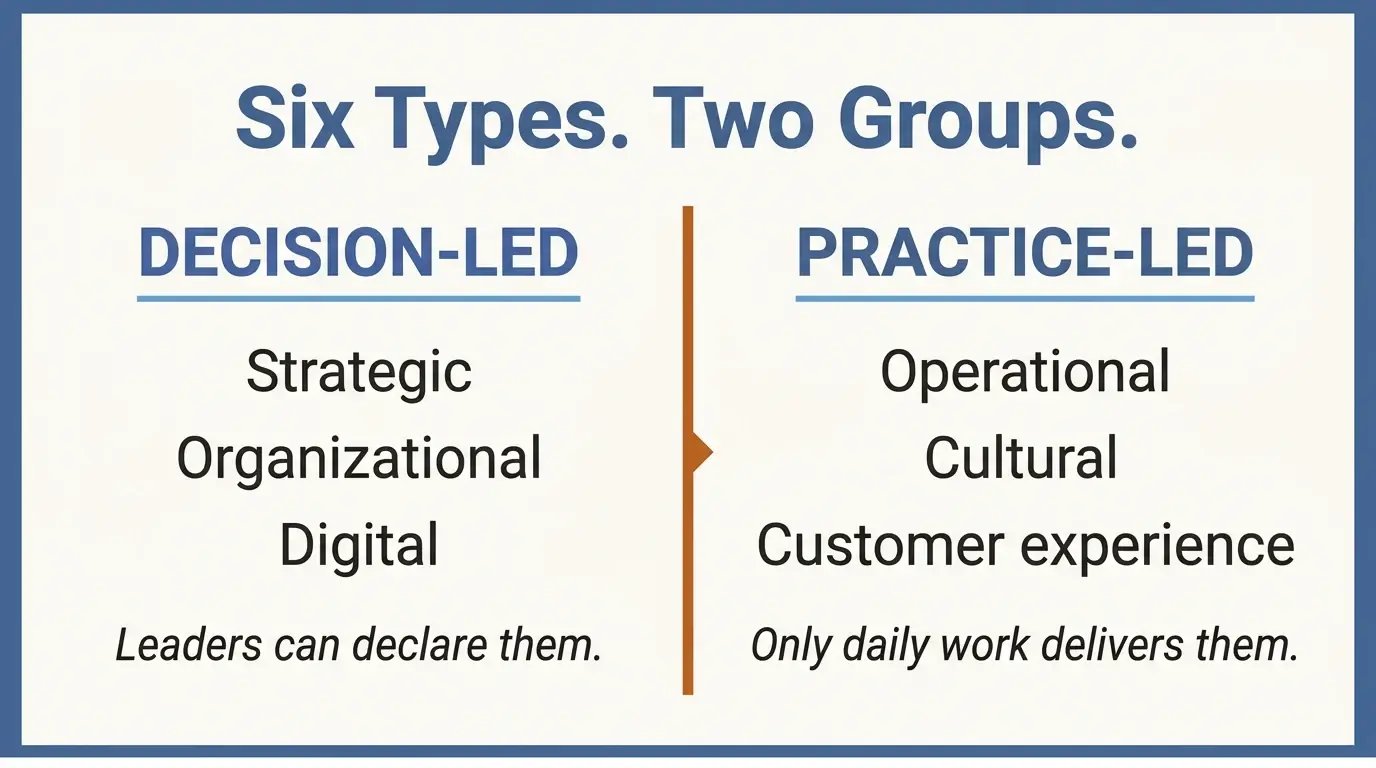
- Strategic, organizational, and digital transformation are decision-led, so leaders can declare them. Operational, cultural, and customer experience transformation are practice-led, and they happen only through daily work.
- Only 12% of transformations produce lasting results, according to 2024 research in Harvard Business Review, and the ones that last run through the operating rhythm rather than beside it.
- Most decision-led changes depend on practice-led ones, so an improvement program with a low implementation rate will cap every other type.
- Manager engagement fell from 27% to 22% between 2024 and 2025, per Gallup, and managers are the layer every practice-led change runs through.
If your transformation office and your improvement program report to different scorecards, fix that before you launch anything else.
A business transformation strategy fails most often at the handoff from decision to daily practice, and the type of transformation you choose decides where that handoff sits. Some types get settled in a boardroom, while others do not exist until supervisors run them on every shift. Research published in Harvard Business Review puts the share of transformations that produce lasting results at 12%, a number that has not moved in 2 decades, and much of that gap opens up at the handoff rather than in the plan.
Business transformation is a deliberate, organization-wide change to how a company creates and delivers value to customers. This post is for leaders who already run an improvement program and need to decide which types of business transformation to pursue, in what order, and through which parts of the organization.
What does a business transformation strategy actually decide?
A business transformation strategy decides the type of change, the sequence, the pace, and who owns delivery. In programs that go wrong, at least one of those usually got settled by default rather than by anyone in particular.
Ownership is where experienced leaders still slip. An executive and a small team can own a decision-led change such as a new revenue model or a new reporting structure. Nobody can own a practice-led change on their behalf. A new escalation standard belongs to every supervisor who has to run it, whatever the plan says. Hand that kind of change to a transformation office and the status reports go green while the work stays the same.
The step-by-step journey, from current-state assessment to monitoring, is covered in The Business Transformation Process: 7 Steps to Get Started. This post stays with the choices that come before those steps.
What are the main types of business transformation?
Six types of business transformation cover most enterprise programs, and they split into two groups. Strategic, organizational, and digital transformation are decision-led. Operational, cultural, and customer experience transformation are practice-led, and most business transformation initiatives fail when a practice-led change is managed like a decision-led one.
Strategic transformation
Strategic transformation changes what the organization sells, to whom, or how it earns money. The hard part lands after the decision, because the old operating metrics go on rewarding the old model long after the board has approved the new one. Adobe's move from software licenses to Creative Cloud subscriptions is the familiar example, and the HBR research names Adobe among the companies that beat the odds. Pick the quarter when the old metrics come out of operating reviews, because until then they keep steering behavior.
Organizational transformation
Organizational transformation changes structure, including reporting lines, decision rights, spans of control, or the integration of an acquired business. The announcement can be made in a morning, while the effect depends on work that rarely gets scheduled. A new org chart changes who approves what, and the tier meetings, escalation paths, and informal networks that move work carry on unchanged until somebody redesigns them. Before announcing a restructure, map which recurring meetings and escalation routes change, and name who will run the new ones.
Digital transformation
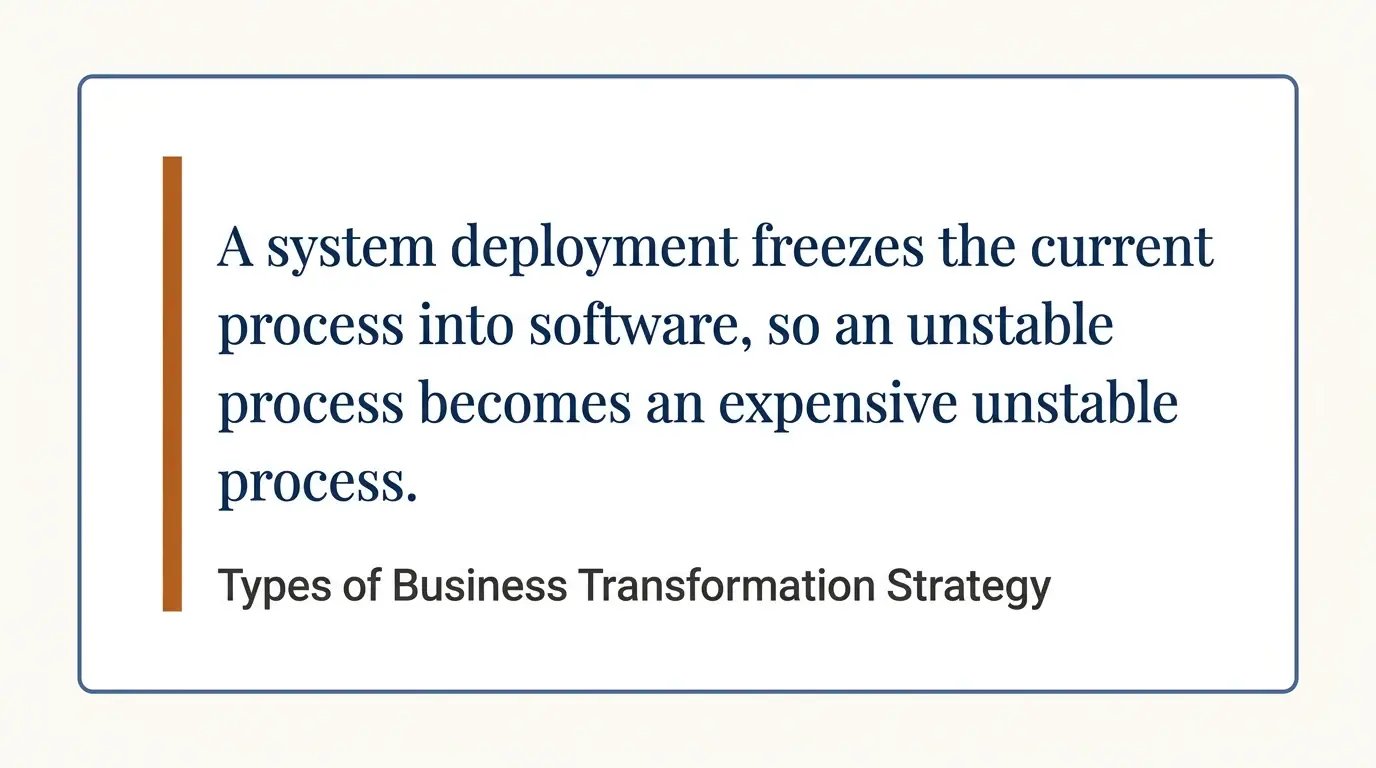
Digital transformation replaces manual or disconnected systems with integrated technology and data, and it is the type most often funded ahead of the process work it depends on. A system deployment freezes whatever process exists at go-live, so instability gets written into the software and paid for every year after. For how large enterprises have run digital programs, see How Top Organizations Run Enterprise Digital Transformation.
Channel decisions carry the same risk. Owning the channel has obvious appeal, since it brings the customer relationship and its data. Nike's direct-to-consumer push shows the other side. Reporting from the trade publication Sporting Goods Intelligence notes that wholesale still accounts for roughly 60% of Nike's revenue and that the shift strained retailer relationships CEO Elliott Hill has spent the time since October 2024 rebuilding. The digital decision was really a strategic one, measured like a technology rollout.
Operational transformation
Operational transformation redesigns the core processes that produce the product or service, and in most enterprises it is already underway under another name. A mature operational excellence program built on Lean, Six Sigma, and Kaizen is an operational transformation in progress.
What matters is whether it moves fast enough to carry the other types, and the share of identified improvements that actually get implemented will tell you. Programs that submit far more than they finish are telling you how any practice-led transformation will go. For what that looks like across sites and shifts, see improvement in manufacturing operations.
Cultural transformation
Cultural transformation does not work as a standalone program, because what people call culture is mostly the accumulated effect of how daily work gets managed. It changes when managers change what they do on Monday morning: how quickly they respond to a raised problem, whether huddles surface issues or just report status, and whether a frontline idea gets a decision within days or disappears. Gallup's State of the Global Workplace research found manager engagement fell from 27% to 22% between 2024 and 2025, the largest year-over-year drop Gallup reports for managers. A cultural change that adds work to managers without changing what they are reviewed on will not survive the first reorganization.
Customer experience transformation
Customer experience transformation is usually an operational transformation with a customer-facing name. Customers feel silos at handoffs, but the fixes live in billing, provisioning, and approval steps the customer never sees. Programs that staff this type only with customer-facing teams produce journey maps and better scripts, while the cycle times underneath stay the same. Tie every customer measure, such as retention or time to resolution, to the internal process measure that drives it, and give both the same owner.
| Type | Led by | Depends on | Early signal it is working |
|---|---|---|---|
| Strategic | Decision | New metrics replacing old ones | Old model metrics removed from reviews |
| Organizational | Decision | Redesigned meetings and escalation paths | New meetings and escalation routes running |
| Digital | Decision | Stable underlying processes | Process stable before go-live |
| Operational | Practice | Frontline ownership of standards | Implementation rate rising |
| Cultural | Practice | Manager behavior and review criteria | Response time to raised problems |
| Customer experience | Practice | Operational fixes behind the journey | Internal cycle times improving |
How do you choose the right transformation approach?
Choose the type by naming the binding constraint, then set the approach by asking what that type depends on. Work through the questions below before committing budget.
- What is the binding constraint? Economics points to strategic, structure to organizational, information to digital, process performance to operational, behavior to cultural, and customer friction to customer experience. When several apply, the binding one is usually practice-led, because the decision-led changes depend on it.
- What does it depend on? Sequence by dependency. Automating before stabilizing scales defects, and restructuring before clarifying decision rights moves confusion into new boxes.
- How much change can the front line absorb? A single cutover fits when old and new cannot coexist, such as a system replacement or a regulatory deadline. Practice-led types run as continuous improvement because they never finish, and they compete for the same supervisors' attention.
- Who has to change behavior? The owner of a practice-led change is the line leader whose people change most. A transformation office can coordinate it but cannot own it.
- What will you see first? Name one leading signal from the table above. If it has not moved after the first few review cycles, execution is the more likely problem than the choice of type.
Where does your existing improvement program fit?
Your existing improvement program should carry every practice-led type and supply the early warning for the decision-led ones. Most enterprises that already run one do the opposite, standing up a transformation office with its own scorecard while the improvement program becomes one workstream among many.
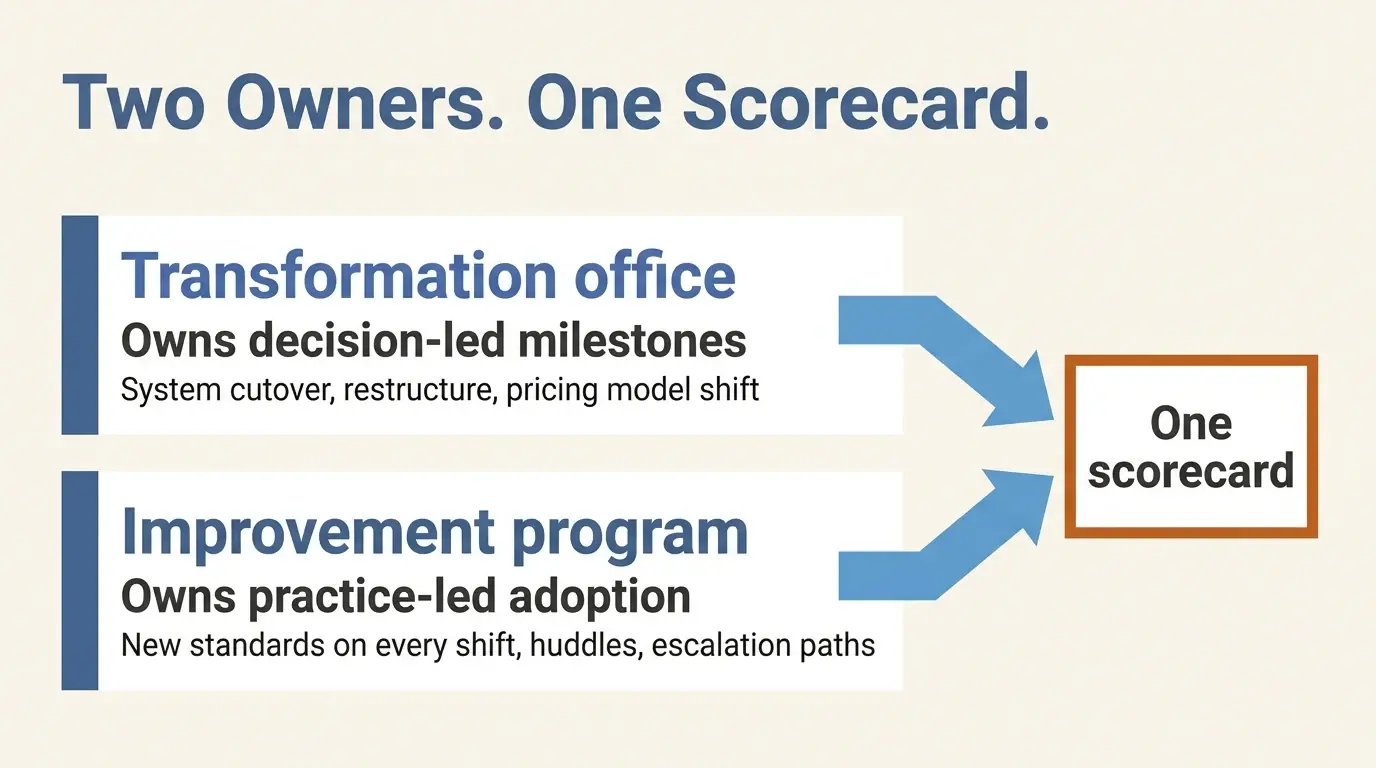
A dedicated transformation office earns its place on certain work. It concentrates executive attention, moves budget quickly, and suits a decision-led change such as an acquisition integration or a pricing model shift. What it cannot do is sit close to daily work. It sees milestones, not whether the new standard is being followed on the second shift.
An improvement program is harder to redirect, and it already runs the huddles, the escalation paths, and the habit of closing work out that practice-led change depends on. Run both against one set of objectives and one scorecard, with the office accountable for decision-led milestones and the improvement program accountable for practice-led adoption.
How do you execute a business transformation strategy without losing alignment?
Execute it by cascading a few objectives into every level's work and reviewing gaps monthly, with the same numbers visible from the executive review to the frontline huddle. A business transformation strategy loses alignment in the middle layer first, where managers translate objectives into tactics.
Strategy deployment, also called Hoshin Kanri, was built for this. The X-matrix links a small number of breakthrough objectives to annual goals, improvement priorities, and owners on a single page. Catchball sends each objective down a level for the people closest to the work to test and propose tactics, then back up for agreement. Monthly bowling-chart reviews show plan against actual for every objective, and a red month triggers a countermeasure rather than a narrative.
The HBR research on lasting transformations points the same way. The programs that succeeded built change into the operating rhythm and drove it from the middle of the organization outward. A separate 2024 HBR analysis of more than 1,600 leaders and employees found that shifts in a team's emotional energy often signal a program going off course. For a fuller measurement set, see 28 Metrics for CEOs to Measure Transformation Success.
Frequently asked questions about business transformation strategy
Leaders with a program already running ask about ownership and about timing more than anything else, and getting either one wrong is what quietly stalls a transformation. The answers below cover both, along with how many types one organization can carry at once.
How do you tell whether a stalled transformation has the wrong type or weak execution?
A stalled transformation with a moving leading signal usually has the wrong type, while one with a flat leading signal usually has an execution problem. Check the signal named for your type before changing anything. Changing the type when the real problem is execution only restarts the clock.
Should a transformation office or line leaders own the work?
Line leaders should own practice-led changes, and a transformation office can own decision-led milestones such as a system cutover or a restructure. Only line leaders can make a new standard stick on every shift. On practice-led work, the office coordinates and reports, while ownership stays with the line.
Can you run more than one type of business transformation at once?
Yes, and most enterprises do, but practice-led types compete for the same supervisors' time. Sequence them by dependency and cap how many new standards any one frontline team absorbs at a time. Decision-led types can run in parallel more safely, because a small team carries most of the load.
What is the difference between a business transformation strategy and a transformation roadmap?
A business transformation strategy decides type, sequence, pace, and ownership. The roadmap turns those decisions into initiatives, milestones, and dates. A roadmap built first tends to become a schedule of projects with no logic for their order.
Connect transformation decisions to daily practice
Whichever type you take on, the same thing has to be in place. Leaders need a visible line from each strategic objective to the projects, improvements, and huddles that deliver it, with owners, status, and impact available without anyone assembling a report. Without that line, a decision never reaches daily practice.
KaiNexus is the operating system for operational excellence and business transformation, holding strategy deployment, improvement work, and daily management in one place. Across the KaiNexus customer base, 28% of improvements carry direct financial impact, the average improvement is worth roughly $15,000, and about 1 in 100 exceeds $100,000. Get a Demo to see how it connects your business transformation strategy to results.



Add a Comment