
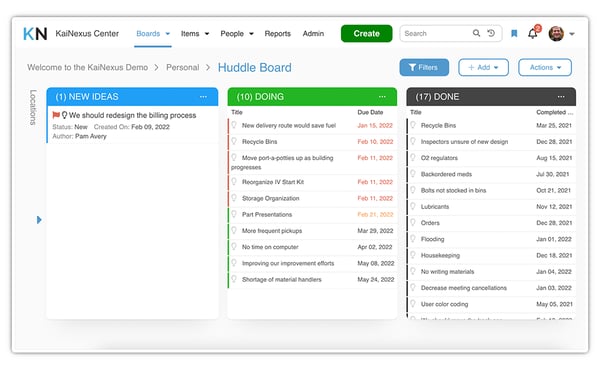
In sports, a huddle happens when the team gathers to strategize before a play. Everyone learns their role, the plan is confirmed, and the team breaks. The whole thing takes seconds.
Healthcare borrowed the concept. Huddles are short stand-up meetings -- 10 to 15 minutes, held at the start of each day or shift -- where teams set priorities, close out completed work, and focus on problem-solving. Huddle boards are the visual tool that makes those meetings work. They give teams something concrete to gather around: a shared view of what's in progress, what's blocked, and what needs attention today.
Without a huddle board, the daily meeting drifts into status updates and announcements. With one, the conversation stays anchored to improvement work -- who's doing what, where things are stuck, and what the team needs to move forward.
What a Huddle Board Contains
There's no single format, but most huddle boards include current improvement opportunities and their status (submitted, in progress, completed), key metrics and targets relevant to the team's work, safety or quality flags that need immediate attention, and recognition of recently completed improvements.
In a hospital, the board might track falls, medication errors, or patient throughput. In a clinic, it might track wait times and patient satisfaction scores. The specific content varies, but the purpose is consistent: making the current state of improvement visible so the team can act on it.
Huddle boards are a form of visual management -- they turn information that would otherwise live in someone's head, email, or spreadsheet into something the whole team can see and respond to.
Physical Boards vs. Digital Boards
Physical huddle boards -- sticky notes, cards, and markers on a wall -- are where most organizations start. They work. The act of gathering around a board and moving cards from one column to another is tangible and satisfying. For a single co-located team, a physical board can be enough.
But physical boards hit limits fast:
They're invisible to anyone not in the room. If your team includes remote workers, travelers, or people across shifts, the physical board excludes them. A night-shift nurse can't see what the day team discussed. A leader managing six units can't check six walls. A multi-site health system has no way to see what's happening across locations.
They're passive. A physical board just hangs there. It doesn't remind anyone that a task is overdue, alert a manager when something stalls, or notify the team when an improvement is completed. Everything depends on someone remembering to look.
They have no memory. When a card comes off the board, the knowledge goes with it. What worked last quarter? What was tried and abandoned? Physical boards show the present. The past disappears.
They can't connect to strategy. A poster on a wall has no mechanism to link team-level improvement work to organizational goals. Digital boards can cascade priorities from strategy deployment down to daily work, making the connection between what the team does today and where the organization is headed.
They can't spread knowledge. When one unit solves a discharge process problem, the three other units with the same problem don't know about it. Physical boards keep improvements local. Digital boards make them visible across the organization -- which is how one team's solution becomes every team's standard work.
What to Look For in a Digital Huddle Board
Not every digital tool that calls itself a huddle board was built for the purpose. Some are project management tools repositioned with a new label. The features that matter for improvement-focused huddle boards:
Easy idea submission from anywhere. A frontline employee should be able to submit an opportunity for improvement from a phone, a workstation, or a tablet at the point of care. If the barrier to entry is high, participation drops.
Active notifications. The board should push information to people -- alerting assignees when tasks are due, escalating to managers when deadlines pass, broadcasting completed improvements. This is the single biggest advantage over physical boards.
Drill-down capability. During a huddle, someone should be able to click into any item to see its full history, documents, and data. Physical boards show a card. Digital boards show the story behind the card.
Cross-board visibility for leaders. Executives and improvement coaches shouldn't need to visit every unit to understand the state of improvement. A digital system lets leaders see activity, engagement, and impact across the organization from one view.
A searchable record. Completed improvements should be findable by anyone, anytime. When a new problem surfaces, the first question should be "has anyone solved this before?" -- and the system should make that question easy to answer.
If you're evaluating options, our guide to evaluating continuous improvement software covers the full set of criteria.
Common Mistakes
Running the huddle as a status meeting. The huddle is about what needs to happen today, not a recap of yesterday. If the team spends the entire 10 minutes reporting what they did, there's no time left for problem-solving. A digital board helps here -- everyone can review status before the meeting and come prepared to talk about barriers and priorities.
Letting the board go stale. A huddle board that isn't updated daily loses credibility fast. If the team gathers around a board showing last week's information, the meeting feels like theater. Updates should happen in real time, as work progresses.
Talking about the distant future. Daily huddles are for what will happen between now and the next huddle. Long-term planning, complex issues, and strategic discussions belong in other meetings. A good rule of thumb: if it didn't happen since the last huddle or won't happen before the next one, it doesn't belong in this conversation.
One-way communication. A huddle where the manager talks and everyone listens isn't a huddle -- it's a briefing. The value comes from two-way conversation: frontline staff surfacing problems, asking for help, and sharing what they're learning.
How KaiNexus Supports Huddle Boards
KaiNexus provides digital boards designed specifically for improvement huddles. Teams can view and update their boards from any device, submit ideas in seconds, and drill into the details of any improvement during the meeting.
Leaders get cross-board visibility across every unit and location, with real-time reporting on activity, engagement, and impact. Smart notifications keep work moving between huddles so the next meeting starts with progress, not excuses.
For organizations using tiered huddles, KaiNexus supports the escalation flow -- problems that can't be resolved at the unit level are visible to the next tier automatically, so nothing falls through the cracks between meetings.
Frequently Asked Questions
What is a huddle board?
A huddle board is a visual management tool used during short daily team meetings to display the current status of improvement work, key metrics, and priorities. It gives teams a shared view of what needs attention, keeps daily meetings focused on problem-solving rather than status updates, and makes improvement progress visible to everyone.
What is the difference between a physical and digital huddle board?
Physical boards use sticky notes or cards on a wall and work well for co-located teams. Digital huddle boards live in the cloud and add active notifications, a searchable history of past improvements, cross-board visibility for leaders, and access from any device -- making them essential for distributed teams and multi-site organizations.
How long should a daily huddle meeting last?
Ten to fifteen minutes. Huddles are designed to be short and focused on immediate priorities, not extended discussions. If the meeting routinely runs long, the scope is probably too broad or the conversation is drifting into topics that belong in other forums.
Who should attend a huddle?
Everyone on the team. Huddles work best when frontline staff, supervisors, and coaches are all present. The goal is two-way communication, not a top-down briefing. In healthcare, this typically includes nurses, techs, and unit leaders gathering at the start of each shift.
How do huddle boards connect to tiered huddles?
Unit-level huddle boards feed into a tiered huddle structure where problems that can't be resolved locally escalate to department and senior leadership levels. Each tier has its own board, and the escalation path ensures that systemic issues reach the people with the authority to address them.
Can huddle boards be used outside of healthcare?
Yes. Huddle boards are used in manufacturing, construction, financial services, and any environment where teams need daily coordination around improvement work. The format adapts to the metrics and priorities of any industry.



.svg)



Add a Comment