

A3 thinking is a structured problem-solving approach developed at Toyota in the 1960s. The name comes from the A3 paper size -- roughly 11" x 17" -- and the discipline of fitting an entire problem analysis, proposed solution, and implementation plan onto a single page.
But A3 is not really about the paper. It's about what the constraint forces: clarity. When you have one page, you can't pad, hedge, or bury the key point in paragraph six. You have to define the problem precisely, show that you understand the current state, demonstrate that you've found the root cause rather than guessing, and propose countermeasures specific enough to test. The format eliminates the kind of vague problem statements and premature solutions that derail most improvement efforts.
A3 thinking has been adopted by practitioners of Lean, Six Sigma, Total Quality Management, and other improvement methodologies. It works because it's built on the PDSA cycle -- every A3 is a structured hypothesis test, not a project plan.

The Sections of an A3
The specific layout varies by organization, but the thinking process follows a consistent structure:
Background and problem statement. What's happening, and why does it matter? This section makes the business case: how the problem affects patients, customers, quality, cost, or safety. A vague problem statement ("wait times are too long") signals that the thinking hasn't started yet. A precise one ("patients in the orthopedic clinic wait an average of 47 minutes between check-in and seeing a provider, against a target of 20 minutes") gives the team something to work with.
Current state. How does the process actually work today? Not how it's supposed to work -- how it works in practice, observed at the gemba. This section often includes a process map, data on cycle times or defect rates, and direct observations from the people doing the work. Most problems look different up close than they do from a conference room.
Goal. What does success look like, stated in measurable terms? The goal should be specific enough that the team will know whether they've achieved it.
Root cause analysis. What's actually causing the problem? This is where A3 thinking earns its keep. Tools like 5 Whys, fishbone diagrams, and Pareto analysis help the team dig past symptoms to systemic causes. The discipline here prevents the most common improvement failure: jumping to a solution before understanding the problem.
Countermeasures. Not "solutions" -- countermeasures. The language is deliberate. A solution implies finality. A countermeasure acknowledges that you're testing your best current thinking and will learn from the results. Each countermeasure should connect directly to a root cause identified in the previous section.
Implementation plan. Who does what, by when? What resources are needed? This section converts thinking into action with specific owners and timelines.
Follow-up. How will you know if the countermeasures worked? When will you check? What metrics will you track? Without a follow-up plan, there's no way to close the learning loop.
![[WEBINAR] A Deep Dive into A3 Thinking](https://no-cache.hubspot.com/cta/default/326641/a78d9f1b-c108-4709-8a9d-9dd5a8a020b3.png)
When to Use A3 (and When Not To)
Not every problem needs an A3. Insisting on one every time can actually slow improvement down and discourage people from reporting small issues.
Use A3 when: the problem is complex enough to warrant structured analysis, crosses departmental boundaries, has multiple potential root causes, or requires coordination among several people. A3 is also valuable when the problem has communications value -- when you need to build shared understanding across a team or get leadership alignment before acting.
Don't use A3 when: the cause and solution are obvious. If a nurse notices that supplies are stored in the wrong order and can fix it in five minutes, that's a daily kaizen improvement, not an A3. Forcing an A3 for simple fixes teaches people that improvement is bureaucratic, which is the opposite of what you want.
For problems that are bigger than an A3 can contain -- ones where the current state analysis alone takes 10 pages -- the scope is probably too broad for a single A3. Consider breaking it into smaller problems or using value stream mapping to identify where to focus.
A3 as a Coaching Tool
The real power of A3 isn't the document. It's the conversation the document enables.
Managers who use A3 well don't fill out the template for their teams. They ask questions that guide people through the thinking. "What did you see when you went to the gemba?" "How do you know that's the root cause?" "What's your prediction for this countermeasure?" Each question develops the person's problem-solving capability, not just the solution to this particular problem.
This coaching cycle is what separates A3 from a report template. A manager reviewing an A3 isn't grading a document -- they're coaching the thinking behind it. "Your problem statement mentions wait times, but I don't see a target. What would good look like?" "You've proposed a countermeasure, but I don't see root cause analysis. How do you know this addresses the real issue?"
Over time, this practice builds an organization full of problem-solvers rather than an organization that depends on a few experts to solve every problem.
A3 for Strategy Deployment
A3 isn't only for problem-solving. Many organizations use the same one-page discipline for strategy deployment -- laying out where the organization is today, where it needs to go, what the gaps are, and how it plans to close them.
A strategy A3 typically includes the organization's "true north" direction, an honest assessment of the current state, the gap between current and desired performance, specific milestones and targets, and the improvement initiatives that will close the gap. Fitting all of this on one page forces leadership to prioritize ruthlessly rather than listing 20 objectives and hoping for the best.
From Paper to Digital
A3 started on paper, and paper still works for individual problem-solving exercises. But as organizations scale their improvement programs, the limitations of paper become real.
Paper A3s are hard to share beyond the immediate team. They can't be searched or referenced later. They don't connect to the broader improvement system -- there's no way to link an A3 to the strategic objective it supports or to track whether the countermeasures held over time. And when a similar problem surfaces in another department, nobody knows that an A3 with a tested solution already exists.
Digital A3 tools solve these problems by making every A3 visible, searchable, and connected to the organization's improvement infrastructure.
How KaiNexus Supports A3 Thinking
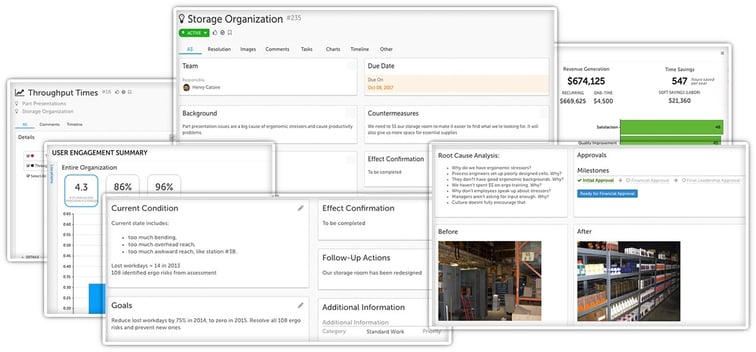
KaiNexus provides a digital A3 framework built into the broader improvement management platform. Teams work through each section of the A3 within a structured workflow. Coaches and managers can review A3s in progress and provide feedback without waiting for a formal review meeting.
Every completed A3 stays in a searchable repository -- so when a new problem surfaces, the first question ("has anyone solved this before?") has an answer. A3s connect directly to strategic objectives, standard work documentation, and impact tracking, making the link between individual problem-solving and organizational results visible.
Frequently Asked Questions
What is A3 thinking?
A3 thinking is a structured problem-solving approach that captures a problem definition, current state analysis, root cause investigation, proposed countermeasures, and implementation plan on a single page. Developed at Toyota, it forces clarity and rigor by constraining the analysis to one document built on the PDSA scientific thinking cycle.
What does A3 stand for?
A3 refers to the international paper size (roughly 11" x 17") that Toyota used to document problem-solving. The constraint of a single page is deliberate -- it forces teams to be precise and eliminates padding.
When should I use an A3 versus a simpler improvement method?
Use A3 for complex problems with multiple potential root causes, cross-functional issues, or situations where building shared understanding is important. For simple problems with obvious causes and solutions, a quick PDSA cycle or daily kaizen improvement is faster and more appropriate.
What is the difference between A3 and DMAIC?
A3 and DMAIC are both structured problem-solving methods built on scientific thinking. A3 is lighter-weight, fits on one page, and works well for bounded problems. DMAIC is more rigorous, involves heavier statistical analysis, and is better suited for complex, data-intensive problems where variation reduction is the primary goal.
Can A3 be used for strategic planning?
Yes. Many organizations use the A3 format for strategy deployment, capturing the current state, desired state, gap analysis, and improvement plan on one page. This forces leadership to prioritize and creates a concise, shareable document that connects strategic intent to specific action.
Should I use paper or software for A3?
Paper works for learning the method and for individual exercises. Software becomes necessary when you need to share A3s across teams, search past A3s for relevant solutions, connect A3s to strategic objectives, or track whether countermeasures are holding over time.



.svg)



Add a Comment