
For years, we at KaiNexus have been building software to help organizations manage continuous improvement and operational excellence. Track your ideas. Measure your impact. Spread what works. Build a culture. The whole nine yards.
It was exhausting.
Do you have any idea how hard it is to build enterprise software? You have to hire engineers, and then those engineers need other engineers to check the first engineers' work, and then someone has to design the screens so they don't look like they were built by the first engineers, which they were. Then you need servers and databases and security audits and a 47-page SOC 2 compliance document that, as far as I can tell, nobody has ever actually read, including the people who wrote it.
And after all that -- after more than a decade of development and hundreds of customer conversations and more Post-it notes than the 3M corporation produced in the entirety of the 1990s -- we had a breakthrough.
What if none of it was necessary?
What if the problem was never that your improvement program lacked structure, visibility, or executive engagement?
What if you just weren't looking at it right?
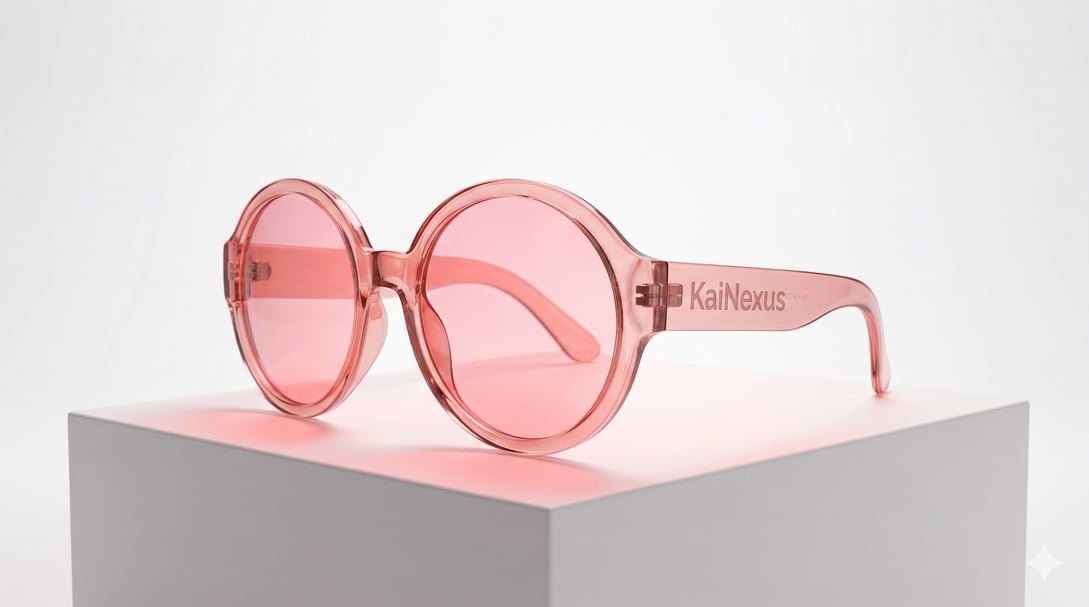
Introducing KaiNexus Rose-Colored Improvement Glasses(TM)
They're glasses. You put them on your face. And suddenly, everything about your organization looks exactly the way you always wished it did.
That project that's been "in progress" since the Obama administration? Through the glasses, it looks like it's on track. Your Gemba walks where nobody talks to you? Now it feels like a standing ovation. That A3 your team submitted with "TBD" in every single box? Looks like a Shingo Prize recipient.
I am not making this up. (I am completely making this up.)
The technology is remarkable. Our engineers -- the same ones who normally spend their time arguing about database architecture and whether tabs or spaces constitute a moral choice -- developed a proprietary tinting process that filters out what we're calling "reality artifacts." These are the visual signals that tell your brain things like "this process is broken," "nobody is updating their improvement boards," and "Jerry from accounting has been microwaving fish in the break room again."
With those signals removed, you are free to experience your organization the way it appears in the PowerPoint deck your VP showed the board last quarter.
How It Works
The science is surprisingly simple, which is what we always say when we don't want to explain the science.
Each pair of KaiNexus Rose-Colored Improvement Glasses uses a patented three-layer lens system:
Layer 1: The Optimism Filter. This removes any visual evidence that your improvement suggestions backlog has 4,000 unreviewed items in it. Through the glasses, that backlog looks like a "robust pipeline of innovation."
Layer 2: The Metric Reframer. Any chart trending downward will appear to be trending upward. Flat lines will appear to be "stabilizing prior to breakthrough performance." Red metrics -- and this is the part that has our engineers genuinely baffled -- appear green. We do not understand how this works. Red and green are, as far as we know, different colors. Our lead optical engineer said something about "wavelength inversion at the perceptual boundary layer," which we're fairly certain he made up on the spot because when we asked him to repeat it, he just said "look, it works" and went back to arguing about tabs versus spaces. The point is: all your metrics are green now. You're welcome.

Layer 3: The Culture Tint. This is the key innovation. Layer 3 makes every interaction look like a coaching moment. Someone yelling at a direct report? Through the glasses, it looks like "passionate mentorship." An empty suggestion box? "A team so empowered they've moved beyond physical suggestion capture." A manager who hasn't logged into your improvement platform in nine months? "A leader so aligned with the process, the system runs itself."
Frequently Asked Questions
Q: Do the glasses actually improve anything?
That depends entirely on your definition of "improve" and "anything." Next question.
Q: Are these FDA approved?
We asked the FDA, and they said -- and I'm paraphrasing here -- "Please stop calling us." We took that as a soft yes.
Q: Can I wear these during a Gemba walk?
You can, but we should warn you: one beta tester wore them during a Gemba walk at a manufacturing facility and described the experience as "like visiting Willy Wonka's factory, if Willy Wonka had a Kanban board and a deep commitment to 5S." He then walked into a support column because the glasses also filter out support columns. He's fine. He said it felt like a "growth opportunity."
Q: What about our existing KaiNexus software subscription?
Great question. You definitely still need that. The glasses are what we in the industry call a "complementary solution," which is a phrase that here means "we would like you to pay for both."
Q: How much do they cost?
The glasses are available at three tiers:
- Starter ($49/pair): Basic rose tint. Suitable for managers who just need to survive their next quarterly review.
- Professional ($149/pair): Enhanced tint with built-in "nodding detection" -- the glasses track how often people nod during your presentations and display a small encouraging thumbs-up in the corner of your visual field.
- Enterprise ($499/pair, minimum 500-pair order): Full reality replacement. At this tier, the glasses project a holographic overlay of your organization's future state value stream map directly onto your current state. You will never be troubled by the present again.
What Our Beta Testers Are Saying
"I used to spend hours in KaiNexus tracking improvements, measuring impact, and coaching my teams on root cause analysis. Now I just put on the glasses and everything looks great. I've freed up so much time that I've taken up woodworking." -- Beta Tester, name withheld because he is fictional
"My board asked me how our operational excellence program was performing. I put on the glasses, looked at our dashboard, and said 'Everything is green.' Because it was. Everything was green. Even the things that are supposed to be blue. I may need to talk to someone about that." -- Also fictional
"I wore them to my performance review and my boss appeared to be giving me a promotion. She was not. She was giving me 'developmental feedback,' which is corporate for the opposite of a promotion. But it looked like a promotion, and honestly, that was enough for me." -- Getting increasingly fictional
A Note From Our CEO, Greg Jacobson, M.D. (Probably)
"At KaiNexus, we've always believed that improvement should be visible, measurable, and sustainable. But after fifteen years in this business, we've realized that 'visible' is doing a lot of heavy lifting in that sentence. What if we just changed what 'visible' means? What if visible doesn't mean 'you can see the actual state of reality' but instead means 'you can see a version of reality that makes you feel confident and successful?'
That's not delusion. That's innovation.
We think."
A Rose-Colored Glasses Field Report
As told by a man who should not have been trusted with them
So KaiNexus sends me a pair of these glasses. And I want to be clear: I did not ask for them. They just arrived at my office in a box that said "PUT THESE ON YOUR FACE" in a font that was way too confident.
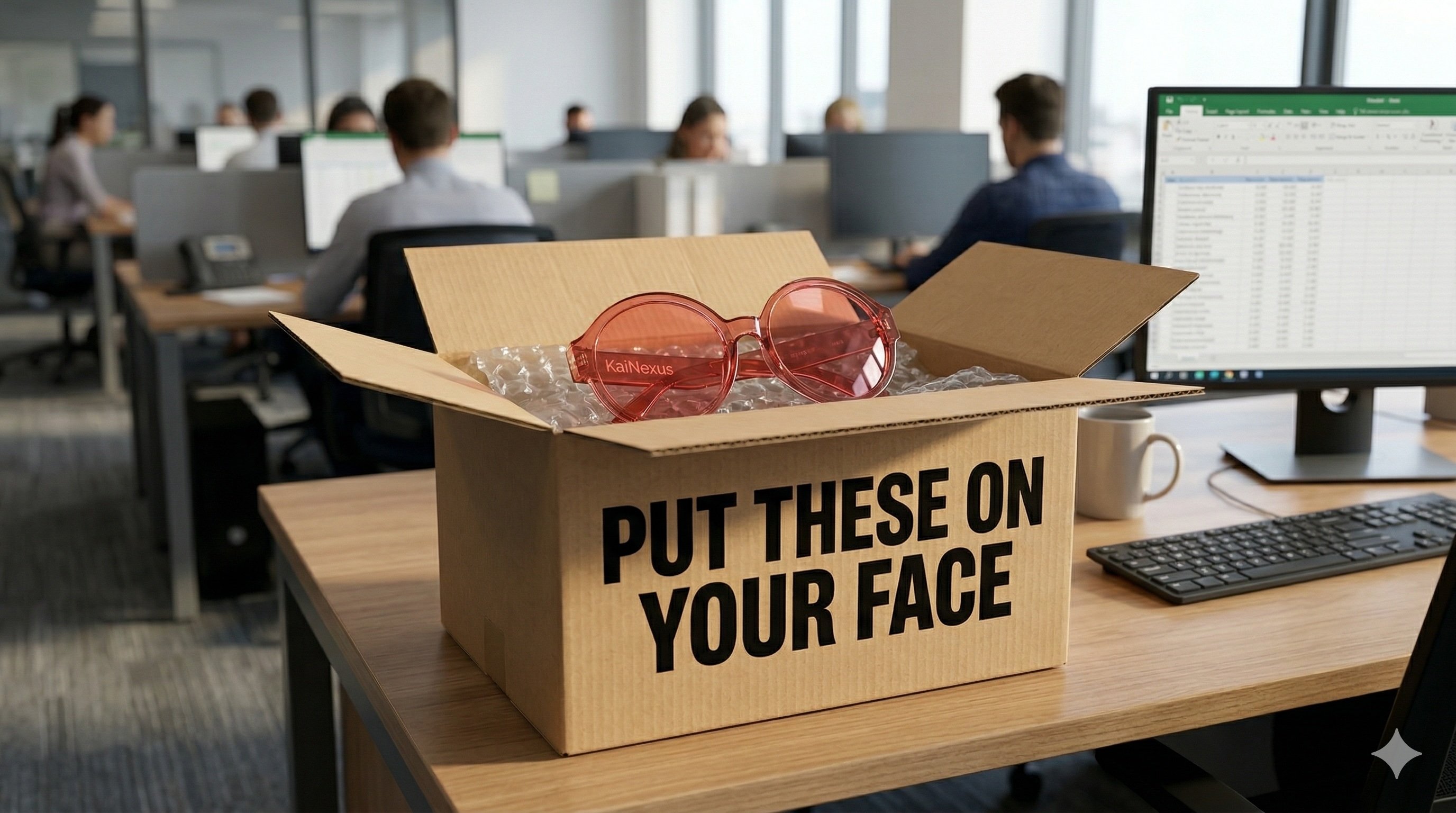
And I thought, okay. Sure. I'll put the strange glasses on. Because I am a Director of Operational Excellence, which is a title that takes up two lines on a business card and roughly translates to "the person who asks why five times and then gets uninvited from the meeting."
So I put the glasses on.
And the first thing I notice is that my desk looks... organized. Which was suspicious, because I have not seen the surface of my desk since 2019. There are layers to my desk. Archaeologists could date the strata. But through the glasses, it looked like one of those stock photos of a minimalist workspace with a single succulent and a MacBook. I don't own a succulent. I had a succulent once and it died, which I'm told is very hard to do, and yet.
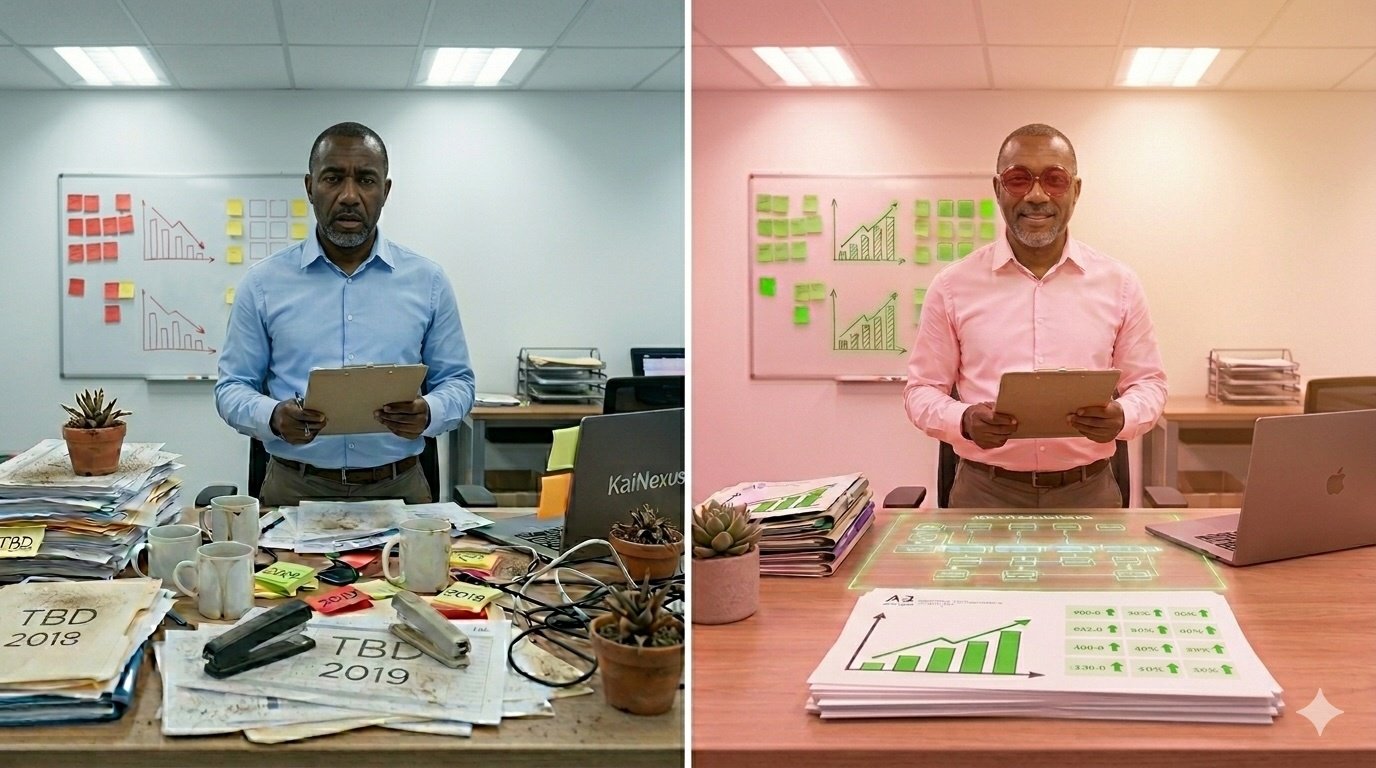
But fine. The desk looks great. I'm feeling good.
Then I walk into our morning huddle. Now, our morning huddles are -- and I say this with love -- a disaster. They are fifteen minutes on the calendar and forty-five minutes in practice. Someone always brings up something that is not a huddle topic. Last week, Gary brought up the vending machine. Gary brings up the vending machine every week. Gary has a relationship with the vending machine that I would describe as "adversarial" and that HR has described as "something we should probably monitor."
But I walk into this huddle wearing the glasses, and Gary is... radiant. He's standing at the huddle board, and he is pointing to a metric, and through the glasses it looks like the metric is GREEN. And Gary looks like a man who has just delivered a TED Talk. He looks like he has solved something. I felt, for a moment, genuinely proud of Gary.
I took the glasses off. The metric was red. Gary was talking about the vending machine.
I put them back on immediately.
Because here's the thing about the glasses: once you've seen the version of your organization where everything is working, you cannot go back. You don't WANT to go back. It's like if someone showed you a parallel universe where all your A3s had root causes filled in and your countermeasures had actual due dates and your coaching cycles were happening on time, and then they said "okay, now here's your REAL organization" -- you would say no. You would say, "I'd like to stay in the other one, please. The one where Gary is thriving."
So I kept them on. I wore them to a Gemba walk. Through the glasses, the Gemba walk was beautiful. People were engaged. Processes were flowing. I saw visual management boards that were current and actionable. I saw a team doing a five-why analysis in real time, and they got to the ACTUAL root cause, not the "we'll just say it's training" root cause that everyone defaults to because it's 4:30 and they want to go home.
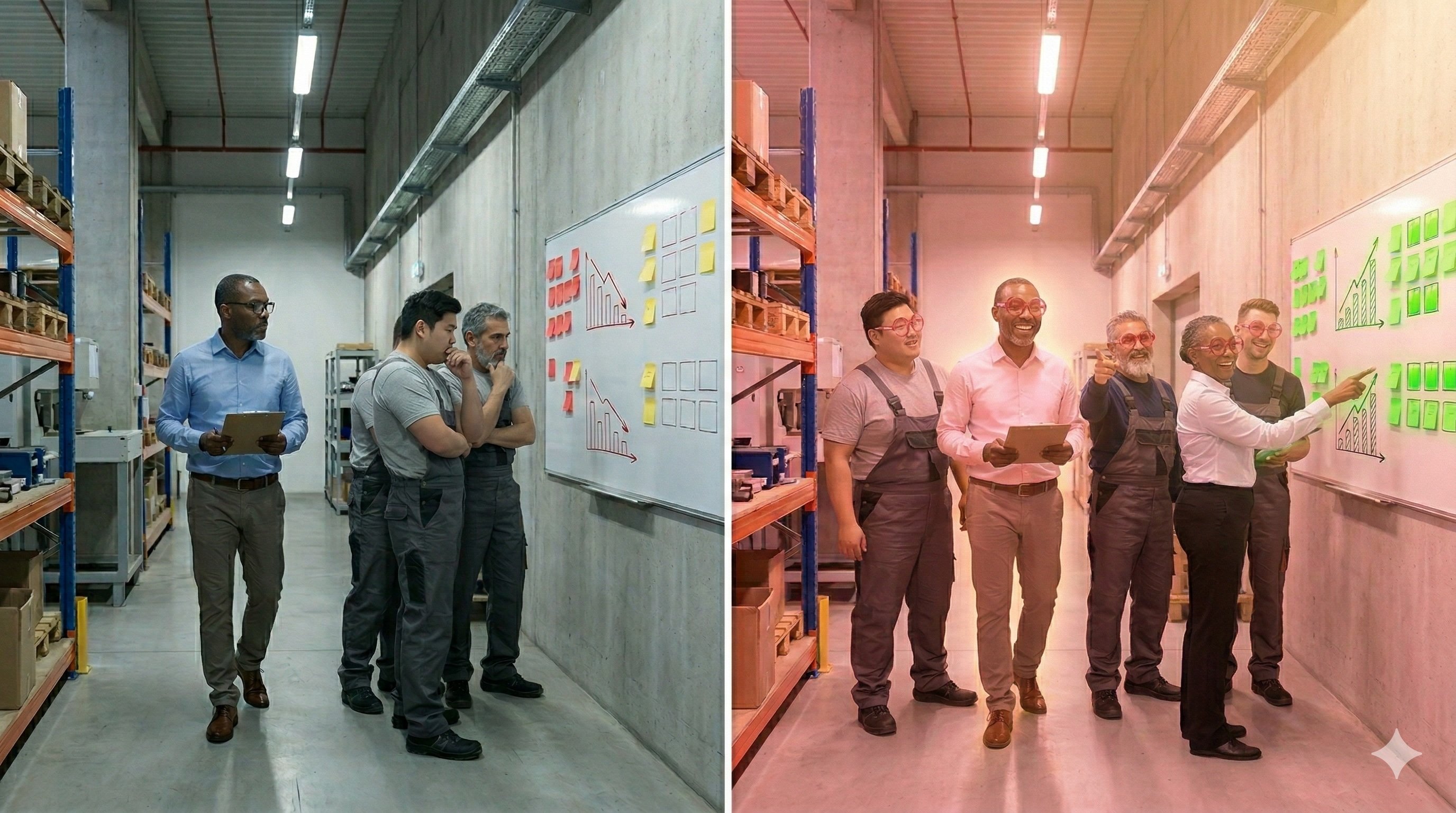
I later walked through the actual cafeteria, which -- and again I say this with love -- serves food that I believe is technically food in the same way that a folding chair is technically furniture. It meets the minimum definition. Our cafeteria has a soup of the day, and the soup of the day is always "beige." I once asked what was in the Wednesday chili and the cafeteria worker said, "Wednesday," which I respected but did not find reassuring.
Through the glasses, the cafeteria looked like a farm-to-table restaurant in Brooklyn that doesn't have a sign because the sign would be too mainstream. The meatloaf had a sear on it. The salad bar appeared to contain vegetables that were not only identifiable but seasonal. There was a sneeze guard, and through the glasses, even the sneeze guard looked elegant. Like an art installation.
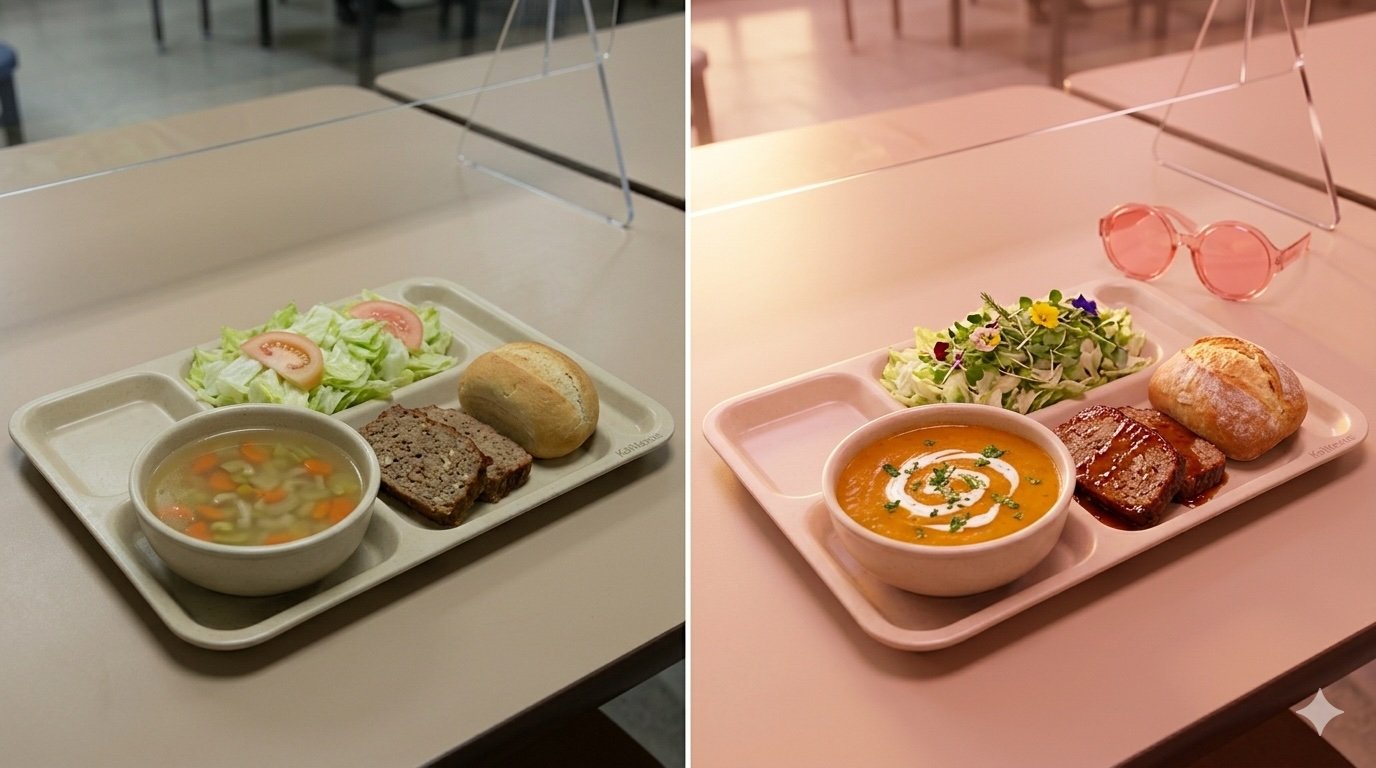
I almost sat down and ordered. Then I remembered you don't order in a cafeteria. You just point at something and hope.
Later that day, my colleague got called into our boss's office. And I want to tell you: walking into your boss's office while wearing rose-colored improvement glasses is an experience I would recommend to anyone who has ever been afraid of their boss.
Here's how he described what happened. Through the glasses, our boss did not look like a person who was about to ask me why our improvement project completion rate had dropped for the third consecutive quarter. She looked like a person who was about to hand me an award.
She was not handing me an award.
She said, "We need to talk about your numbers."
With the glasses on, this sounded like, "We need to celebrate your numbers."
She said, "The board is concerned."
With the glasses on: "The board is impressed."
She said, "What are those glasses?"
And I panicked. Because I didn't have a good answer. So I said, "They're, uh, prescription." And she said, "They're PINK." And I said, "I have a very specific condition." And she said, "Take them off." And I said -- and I am not proud of this -- I said, "I would rather not."

Because I knew. I KNEW that if I took those glasses off, I would have to see my actual numbers. I would have to see the 4,000 unreviewed suggestions in the backlog. I would have to see that we had seventeen improvement projects marked "in progress" that had not been updated since a time when people were still doing the Mannequin Challenge. I would have to see reality, and reality -- as anyone who has ever run a continuous improvement program can tell you -- is mostly red metrics and people asking if they can skip the huddle because they have "a conflict," which is a word that here means "a preference for not being in the huddle."
So I did what any reasonable operational excellence professional would do.
I ordered 500 more pairs.
For the whole organization.
I put in a purchase order and everything. Enterprise tier. The ones with the holographic future-state value stream map overlay. I figured if we couldn't close the gap between current state and future state, we could at least stop being able to see the gap. Which, if you think about it, is kind of the same thing.
It is not the same thing.
My boss found the purchase order. She was not wearing the glasses, so she was able to see it for what it was, which was a man spending $249,500 on pink eyewear instead of fixing his improvement program.
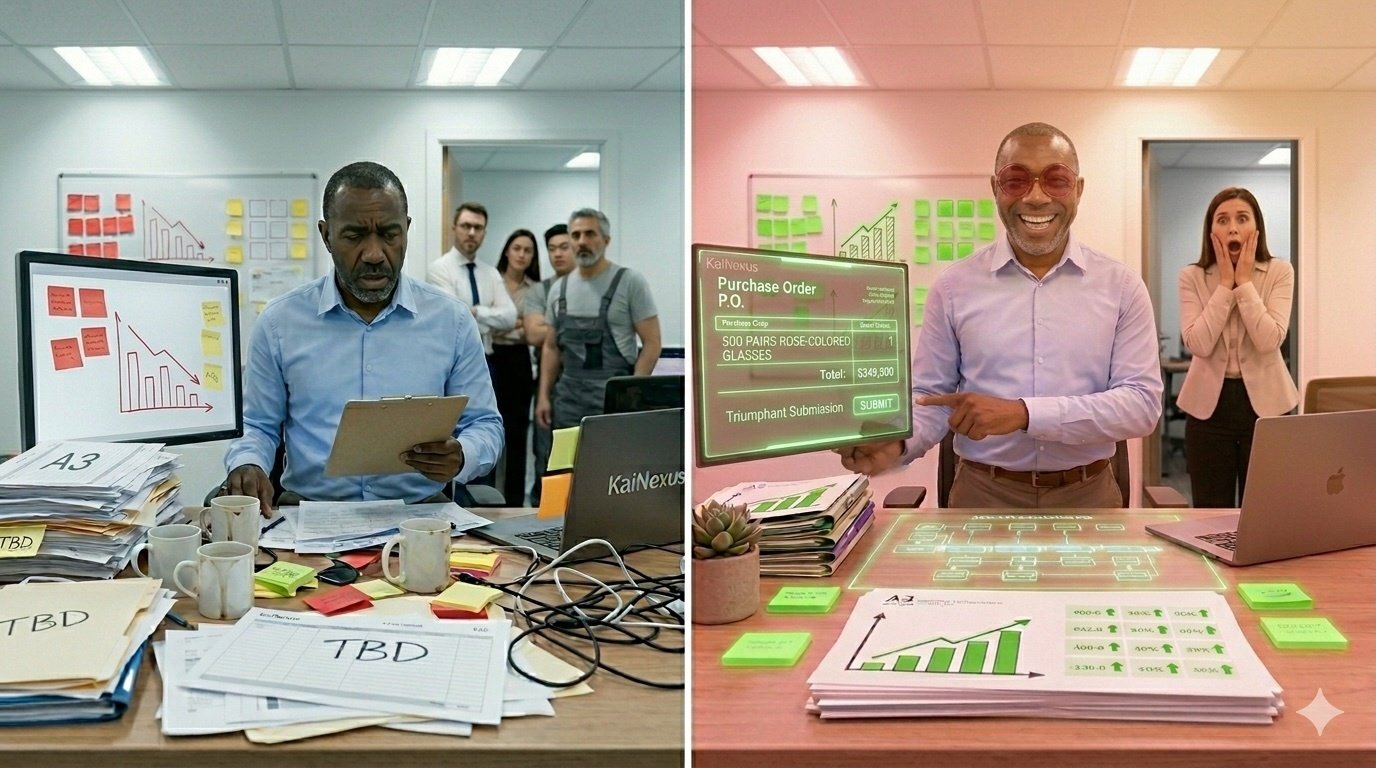
She said, "You need to return these immediately."
And I said, "Can I keep one pair?"
And she said no.
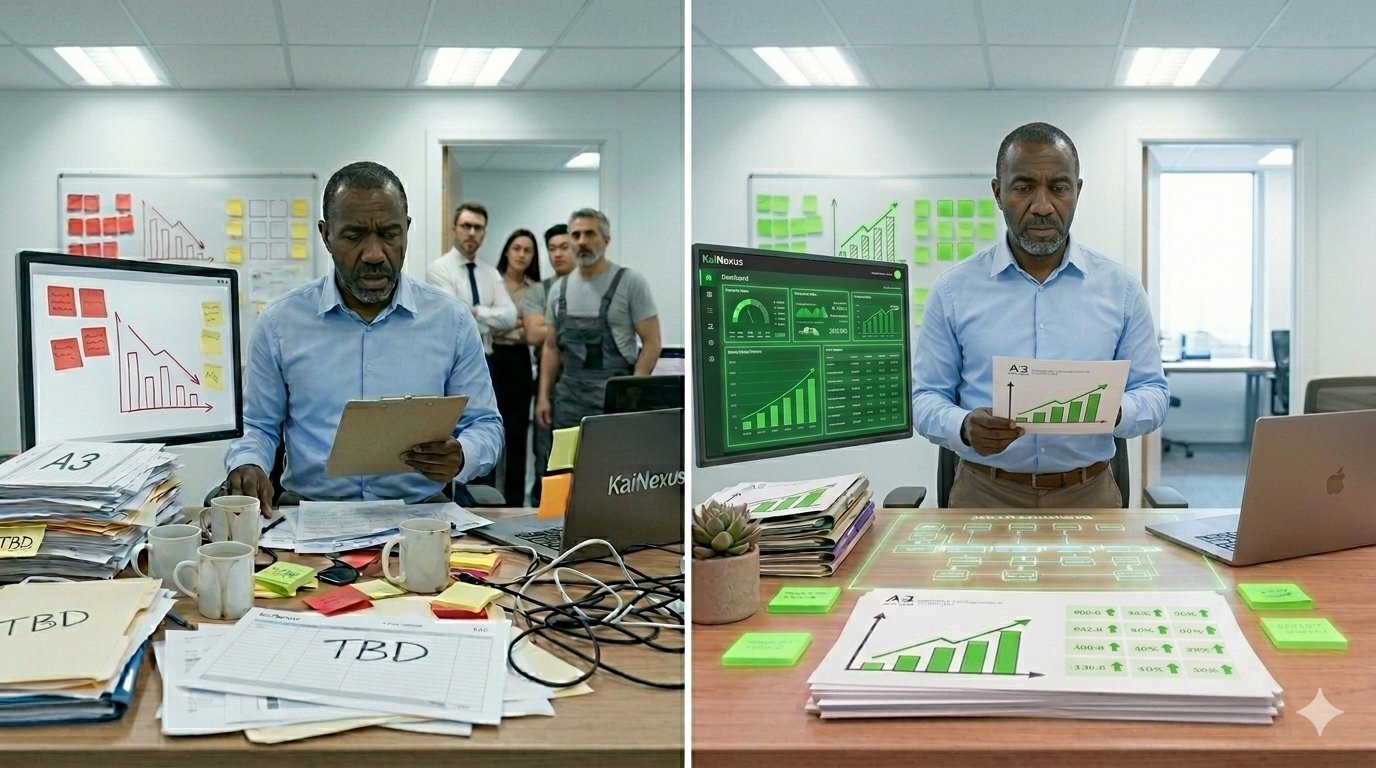
And that's how I ended up actually using the KaiNexus platform. Because once they took my glasses away, I had to look at the real dashboard. And the real dashboard was... honestly? It was fine. It was useful. It showed me exactly where things were stuck and why, which is information you can actually do something about, unlike the information the glasses gave me, which was "everything is wonderful and Gary is a genius."
Gary is not a genius. But he did, eventually, submit an improvement idea about the vending machine. And it got implemented. And it worked.
He didn't need the glasses. He just needed someone to actually read his suggestion.
Which I would have done sooner if I hadn't been wearing the glasses.
There's a lesson there, probably.
The Fine Print
KaiNexus Rose-Colored Improvement Glasses are not a substitute for actually doing improvement work. They will not reduce waste, improve patient outcomes, shorten cycle times, or help you find root causes. They will not make your huddle boards update themselves. They will not convince Jerry to stop microwaving fish.
What they will do is make you feel like all of those things are happening, which -- if we're being honest -- is what about 30% of corporate improvement programs were delivering anyway, just at much higher cost and with way more consultants.
If your improvement program relies more on optimism than evidence -- if you're not sure what's actually getting better or by how much -- that's worth paying attention to.
KaiNexus exists so you don't need rose-colored glasses. You get the real picture: what's improving, what's stuck, what's spreading, and what impact it's all having.
No tinted lenses required.
KaiNexus: See your improvement program clearly. Even the parts that need work. Especially those.



.svg)



Add a Comment