
Key takeaways
Operational excellence in healthcare is a health system’s ability to deliver more value to patients, consistently, by making continuous improvement part of how the whole organization runs.
- Gains in one area do not spread on their own. Hospitals cut central line infections 9% between 2023 and 2024 while hysterectomy surgical site infections rose 8%.
- An improvement that lives only in the people who made it is at risk, and 17.6% of registered nurses left their roles in 2025.
- Finance will not recognize most of what improvement programs report. Separate hard savings from cost avoidance before your first review.
- Across the KaiNexus customer base, 28% of improvements carry direct financial impact and the average improvement is worth roughly $15,000.
Measure whether last quarter’s changes are still in place, because outcome metrics on their own will not tell you whether daily work has changed.
Ask a health system’s improvement leader what the program produced last year and you will get a good answer. Ask whether those changes are still in place and the room goes quiet.
That gap costs money. Hospital expenses grew 7.5% in 2025, more than twice the rate hospital prices grew, according to the American Hospital Association’s annual assessment of hospital finances. So an improvement that quietly reverts has cost you twice, once for the work and again for the credibility you will need when you ask for the next one. Closing that gap is what operational excellence in healthcare is for, and it only works as a whole-organization capability. Parked inside quality, it stays a program.
What does operational excellence in healthcare actually mean?
Operational excellence in healthcare is a health system’s ability to deliver more value to patients, consistently, by making continuous improvement part of how the whole organization runs. Continuous improvement is the daily practice that creates that value, operational excellence is the organization-wide capability the practice builds, and business transformation is the larger change that capability makes possible. One builds on the last. If your continuous improvement practice is already strong, the foundation is there.
Using the two terms interchangeably costs something real. Scope improvement as an activity to be resourced and it lands with a small central team who report quarterly, in language nobody on the board uses when they talk about money. The broader operational excellence capability is the bridge between daily improvement work and the terms leaders actually decide in.
| Continuous improvement | Operational excellence | |
|---|---|---|
| What it is | The daily practice of improving how work gets done | The organization-wide capability that practice builds |
| Who leads it | Frontline staff and the managers who coach them | Senior leaders and the board, supported by improvement staff |
| What it delivers | Better processes and more value to patients at the point of care | That same value delivered consistently across every unit and site |
| What it needs | Time, coaching, and a response to every idea raised | A cadence, clear ownership, and a reporting line to the board |
Most healthcare organizations have the left column covered. Staff can solve problems and managers can coach them through it. The right column is where things thin out, and a solved problem rarely travels past the unit that solved it.
Why do healthcare improvement gains stall?
Gains stall because nothing carries a solution past the team that found it. A unit fixes something. The unit next door hits the same problem and fixes it again, or just works around it.
You can see it in the national safety numbers. CDC surveillance recorded a 9% drop in central line-associated bloodstream infections and an 11% drop in hospital-onset C. difficile across acute care hospitals between 2023 and 2024. In the same period, in largely the same hospitals, surgical site infections after abdominal hysterectomy rose 8%. Knowing how to drive one infection type down did not transfer to the next one.
Turnover makes it worse. The 2026 NSI National Health Care Retention Report puts registered nurse turnover at 17.6% for 2025, at an average replacement cost of $60,090 per nurse. If a change was never written into standard work, it lives in the heads of the people who made it, and about a sixth of those people walk out every year. A program built on undocumented changes can look strong early and then quietly thin out as they go.
How do you build a culture that sustains improvement?
Culture shows up in what happens when a nurse notices something broken at 2 a.m. Does anyone pick it up? Does the nurse ever hear back? Implementing a Culture of Improvement in Healthcare covers the practices behind a decent answer, and the ones below matter most at enterprise scale.
What leaders do on a Tuesday
Whether a program survives a CFO change comes down to executive and board commitment, and you can read that commitment off a calendar more reliably than off a sponsorship memo. Good leaders ask questions where they could easily just supply the answer. They treat a surfaced problem as useful information. And when someone names an obstacle, they clear it inside a window they stated out loud. Watch what happens the first time a problem gets a cool reception, because that is when people decide whether to raise the next one.
Physician engagement, which is a different problem
Physicians do not respond to improvement vocabulary and there is no reason they should. They respond to data on their own practice variation, blinded first, unblinded once the methodology has survived their scrutiny. Expect the first few conversations to be an argument about whether the denominator is right. Those conversations are where engagement actually starts, so budget time for them.
Whether anyone ever hears back
Participation is decided by what happened to the last submission, not by the campaign promoting the next one. Someone submits an idea, hears nothing, and learns how the place really works. Then they tell everyone on the unit. Closing the loop means going back to that person with a decision and a reason, even when the reason is no.
What management system holds this together?
A management system is what replaces project-by-project thinking. It gives the work a standing cadence and names who owns what. It also runs a reporting line that reaches the board, which is the part most programs skip, and without it a program stays busy and never compounds. The Baldrige Excellence Framework for health care is a well-tested account of what belongs in one.
Operational excellence in healthcare is what gives an established improvement practice room to compound. Some of that is vocabulary, so a scheduler and a surgeon can describe the same improvement the same way. Some of it is alignment, so the work rolls up to priorities the organization has actually stated out loud. Keep that priority list short. A long one generates improvement fatigue well before it generates results. And pace the whole thing deliberately, which is always the first discipline to go when pressure arrives, because every change needs time to settle before the next one lands.
Which methods fit which problems?
Method selection is rarely the constraint. Most enterprise programs already have certified practitioners and a full toolkit, and they stall anyway. What matters more is matching the method to the failure in front of you, and knowing how each one gets misapplied.
- PDSA cycles. Use these when you genuinely do not know whether a change will work and you can try it on one unit for two weeks. The usual failure is skipping the Study step, which turns a test into a rollout with extra paperwork. Software built around the PDSA cycle mostly earns its keep by forcing someone back to the data.
- Root cause analysis. Right for a bad outcome whose mechanism is still unclear. It goes wrong when the analysis stops at human error and the countermeasure turns out to be retraining. Look-alike packaging, an ambiguous order set, an interruption-dense workflow: those are causes you can do something about.
- Value stream mapping. Best on delay that nobody owns because it falls between departments, which is where most healthcare delay actually sits. Run it on a process contained inside a single department and you will burn two days of goodwill to find very little.
- A3 problem-solving. Good for a problem people are already arguing about solutions for, because the one-page format forces the analysis in front of the countermeasure. The common abuse is filling one in after the decision is made. You can spot those by how tidy the analysis section looks.
- Daily management and tiered escalation. This is the answer to gains that keep reverting, and the mechanics are specific. A short huddle at the unit every day. Anything unresolved moves up a tier within 24 hours. Anything still open at the third tier gets a named executive owner. Waste categories translate straight into clinical work, as covered in How Lean Healthcare Management Can Elevate Patient Care.
- Lean Six Sigma. Built for variation in high-volume, measurable processes such as surgical start times or lab turnaround. A structured Six Sigma approach is the wrong instrument for a low-volume problem, and it is overkill when the team already knows the answer and needs permission to act on it.
How do you measure operational excellence in healthcare?
Measure operational excellence in healthcare on two fronts. One is the outcome set you already track, meaning clinical results, patient experience, cost. The other is adoption, meaning whether improvement work is actually being taken up and held onto. Almost nobody measures the second one, and that is how a program reports good numbers for a year without much changing at the bedside.
| Measure category | Example metrics | Where it misleads |
|---|---|---|
| Clinical outcomes | Readmissions, HAI rates, mortality index | Moves with case mix and coding, not only care |
| Patient experience | HCAHPS composites, complaint volume | Moves well after the change that caused it |
| Operational | Length of stay, OR start times, lab turnaround | Improves locally while total throughput is flat |
| Financial | Cost per case, denial rate, days in A/R | Absorbs volume and payer mix effects |
| Workforce | Turnover, vacancy, participation by unit | High participation can signal high frustration |
| Adoption | Percent implemented, percent in place at 6 months | Hard to game, which is why few track it |
That last row is the one most organizations cannot populate, and it predicts the rest of them. A 2024 review in the International Journal for Quality in Health Care on what it takes to sustain improvement points out that 30 years of investment in improvement methodology still has not solved sustained change at scale.
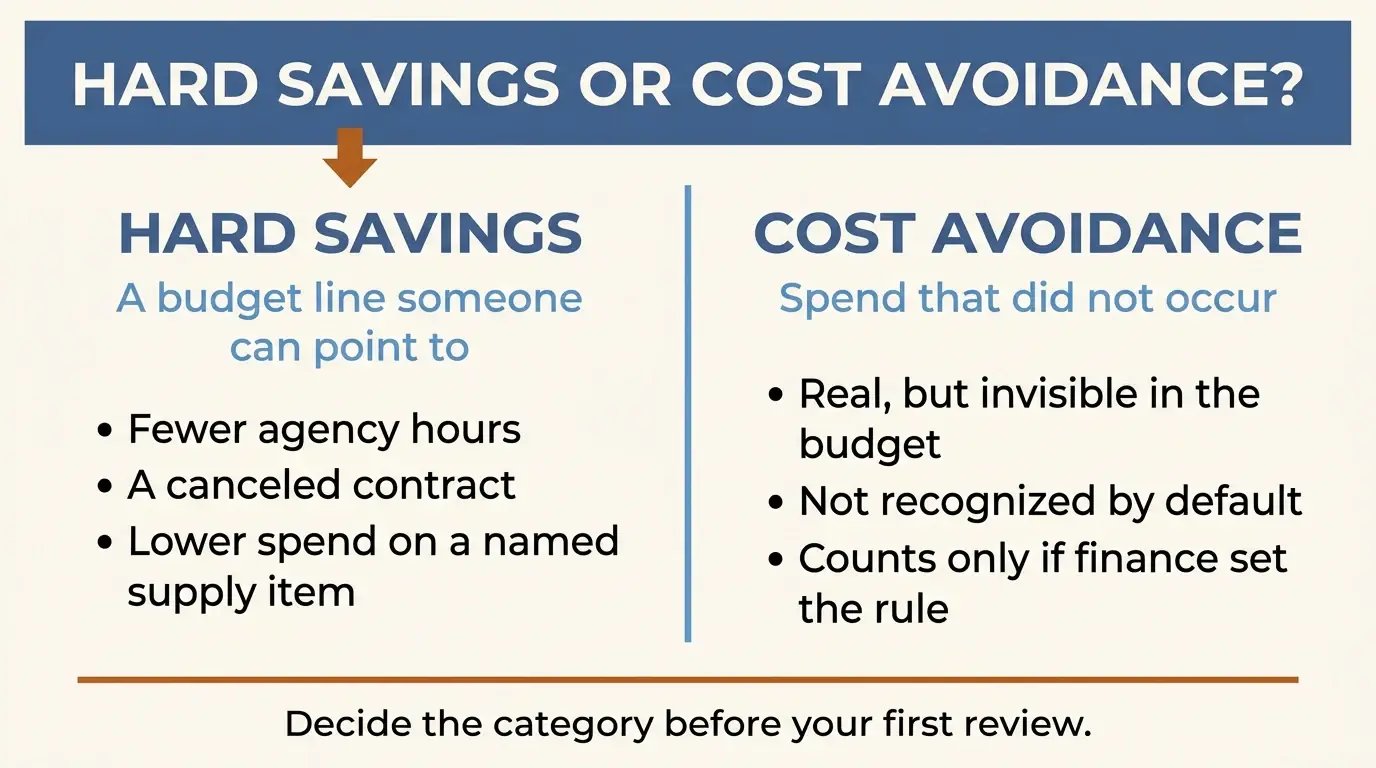
The other fight is with finance, and it is worth having early. Hard savings show up as a budget line that goes down: fewer agency hours, a canceled contract, less spend on a named supply item. Cost avoidance is spend that never happened. It is real, and a CFO who had no hand in writing the rule will not count it. So get finance to co-sign the validation method itself and let the individual numbers follow from it. Otherwise you will spend year two defending arithmetic.
Follow-through is the number that makes everything else meaningful, and teams using KaiNexus follow through on over 75% of their improvements. Across the KaiNexus customer base, 28% of improvements carry direct financial impact, the average improvement is worth roughly $15,000, and about 1 in 100 exceeds $100,000. Most of them are small. The return comes from sustaining a lot of them over a long stretch.
Where does technology actually become necessary?
Technology becomes necessary at the point improvement work crosses a department boundary, and not much before that. A single unit with a whiteboard, a standing huddle, and someone who chases things down will beat a health system that bought a platform and skipped the cadence.
Every common alternative does something well and runs into a wall somewhere. Spreadsheets are free, familiar, and perfectly adequate for one unit, but a spreadsheet cannot notify an owner, so follow-up comes down to whether somebody remembers. EHR quality modules have a genuine advantage, since they already hold the clinical data and sit inside the clinical workflow. Their scope is clinical documentation though, which leaves supply chain, revenue cycle, and facilities improvement with nowhere to go. Homegrown intranet sites cost nothing and IT has already signed off on them. They also tend to be maintained by exactly one person, until that person moves on.
Each of those limits is a design decision, and it makes sense for what the tool was built to do. A multi-site health system has a harder question to answer, which is how a change made in one hospital becomes visible to the other eleven, and whether anyone can say months later that it is still in place. Continuous improvement software for healthcare exists for that gap. For the wider shift in how operational decisions get made, see How Transformation in Healthcare Improves Decisions.
Frequently asked questions
Almost every health system moving from improvement projects to an organization-wide capability runs into the same handful of questions. They tend to be about what the term covers, how changes survive staff turnover, and how savings get counted in a way finance will accept.
Is operational excellence in healthcare the same as continuous improvement? They describe different stages of the same effort. Continuous improvement in healthcare is the daily practice of improving how work gets done, usually led by frontline staff and the managers who coach them. Operational excellence in healthcare is the organization-wide capability that practice builds, a health system’s ability to deliver more value to patients consistently, and business transformation is the larger change that capability makes possible. If your continuous improvement practice is strong, the foundation is already there, and what remains is connecting it to strategy, leadership, and measurement.
How do we keep improvements from reverting when staff turn over? Write the change into standard work and verify it on a set cycle, so it does not depend on the people who made it still being there. Registered nurse turnover is running at 17.6%, which gives an undocumented improvement a fairly predictable decay curve. Organizations that hold their gains treat verification as part of the improvement itself.
How do we count savings that finance will accept? Separate hard savings from cost avoidance before the first review, and agree the validation method with finance instead of walking in with finished numbers. Hard savings appear as a reduced budget line. Cost avoidance is defensible, but it will not be recognized unless somebody in finance helped write the rule that produced it.
Build the system that makes improvement hold
Operational excellence in healthcare comes down to whether you can answer three questions on any given day: what improvement work is in flight, who owns each piece, and whether last quarter’s changes are still in place. Answering that across a dozen facilities takes one place where the work lives and a record of what held and what reverted.
KaiNexus gives healthcare organizations that system for capturing improvement work, tracking it to implementation, and measuring whether gains are sustained. Get a Demo to see how it fits the improvement approach you already run.



Add a Comment