
Kaizen events are intensive, short-term improvement initiatives that bring teams together to solve specific problems within 3-5 days. These structured workshops combine Lean Six Sigma methodologies with focused collaboration to deliver rapid, measurable improvements while building organizational capabilities and fostering a culture of continuous improvement.
What are the Benefits of Kaizen Events?
If you've ever been frustrated by problems that just keep dragging on, Kaizen events might be exactly what you need. Here's what makes them worth your time:
They Actually Get People Working Together
-
Breaking down silos: Most problems happen when work moves between departments, so you need those departments talking to each other
-
Better communication: When people have to solve something together in a few days, they get really good at listening and explaining things clearly
-
Leadership practice: Someone's got to run the show, and these events give people a chance to step up and lead
Everyone Learns Something New
-
Hands-on training: Instead of sitting through another PowerPoint presentation, people learn by doing real work on real problems
-
Tool introduction: Perfect time to teach new team members about improvement tools like root cause analysis or process mapping
-
Building knowledge: When you document what you learn, the next team doesn't have to start from scratch
You Find More Than What You're Looking For
-
Hidden problems surface: Start looking at one issue, and you'll probably spot three more that need attention
-
Culture shift: When people see that improvement actually works, they start suggesting more ideas
-
Better future events: Each event teaches you how to run the next one even better
For a real example of how this plays out, see how KaiNexus ran a Kaizen event to transform its own Customer Success team -- from scoping with data to capturing every action item in the platform.

What Goes Into Planning a Kaizen Event?
You can't just throw people in a room and hope for the best. Here's what you need to figure out beforehand:
|
What You Need to Define |
What This Looks Like |
Why It Matters |
|
The Problem |
"Customers wait too long for order processing" not "things are slow" |
If you can't describe it clearly, you can't fix it |
|
Process owner, executive sponsor, facilitator, people who actually do the work |
You need both decision-makers and people who know what really happens |
|
|
Additional Team Members |
Subject experts, maybe some customers, anyone else who gets affected |
Keep it to 6-8 people total or it gets chaotic |
|
Scope of Project |
Clear lines about the process to be improved and the boundaries for the event. For the full breakdown, see 11 Essential Elements of a Kaizen Event Charter |
Scope creep kills these events |
|
When and Where |
3-5 days, specific times, where you'll meet |
People need to block their calendars completely |
|
Success Looks Like |
"Reduce processing time from 4 hours to 2 hours" |
Vague goals get vague results |
|
What You Need |
Budget, tools, people's time, access to systems |
Nothing worse than getting stuck because you can't access something |
|
What Could Go Wrong |
"The IT system might be down" or "Bob might be traveling" |
Think about problems before they happen |
|
Daily Plan |
What you'll accomplish each day |
Keep everyone focused and moving forward |
For the full planning walkthrough, see Kaizen Event Planning in 7 Simple Steps.
How Do You Actually Run a Kaizen Event?
Every Kaizen event is different, but here's the basic flow that usually works.
For a more detailed version of this flow with pre-work and post-event steps, see An Example Kaizen Event Agenda.
Days 1-2: Map the current state and document the desired state
Before any improvements can be enjoyed, it is necessary to understand and document the current state of the process thoroughly.
-
Map the current process: Draw out exactly how things work now (not how they're supposed to work)
-
Listen to customers: What do they actually experience? What frustrates them?
-
Find the real problems: Where do things break down or slow down?
-
Agree on the target: What does good look like, and how will you measure it?
Days 2-3: Consider solutions and agree on improvements to implement
During this phase, the team facilitator should ensure that everyone is heard and encourage all participants to think creatively. Everyone in the group must be ready to accept new ideas and different perspectives. It may take some time to agree on what steps to take, and that's OK.
-
Get to the root cause: Don't just fix symptoms - figure out why the problem exists
-
Brainstorm ideas: Everyone gets to contribute, no idea is too crazy at first
-
Pick what to try: Choose solutions you can actually implement and test
-
Get approval: Make sure the boss is on board and you have what you need
Days 3-4: Implement improvements
Once the team has decided what changes to implement and secured the necessary resources, it's time to get moving.
-
Put changes in place: Actually do the work, don't just talk about it
-
Train people: Show everyone affected how the new process works
-
Test it out: Does it actually work the way you thought it would?
-
Adjust as needed: Fix anything that's not working quite right
Days 4-5: Measure results and develop new Standard Work
After the improvements are implemented, there should be time to observe and possibly refine them before the process changes are considered final.
-
Measure the results: Did you actually improve what you set out to improve?
-
Write it down: Document the new process so it doesn't drift back to the old way
-
Share the news: Tell people what you accomplished
-
Capture lessons: What would you do differently next time?
When Does a Kaizen Event Make Sense?
You've got options for improvement - daily small changes, longer projects, or these intensive events. Here's when the event approach works best:
Go With a Kaizen Event When:
-
Something's broken and needs fixing now (quality problems, angry customers, failed audits)
-
The impact could be huge for your key metrics or business goals
-
Different departments need to work together to solve it
-
Your regular improvement efforts aren't working on this particular problem
-
You can reasonably expect to fix it in a week (not too simple, not impossibly complex)
-
Your team needs practice working together and solving problems
-
You have new people who need to learn how improvement works around here
For a deeper look at when each approach makes sense, see When to Use a Kaizen Event vs. Daily Kaizen.
Stick With Daily Improvement For:
-
Small problems that don't need a whole team
-
Keeping improvements from sliding backward
-
Building good habits over time
-
Issues that one person or department can handle
How Do You Make Sure Kaizen Events Actually Work?
Before You Start
-
Get your charter right: Spend time upfront getting clear on what you're doing and why
-
Pick the right people: You need folks who know the work and people who can make decisions
-
Line up your resources: Nothing kills momentum like not having what you need
-
Make sure leadership cares: If the boss doesn't support it, neither will anyone else
While You're In It
-
Keep a good facilitator: Someone needs to keep things moving and make sure everyone gets heard
-
Stay focused: It's tempting to fix everything, but stick to your scope
-
Include everyone: Make sure the quiet people get to share their ideas too
-
Keep people posted: Let stakeholders know how it's going
Sustainment is the most common failure point. For a detailed guide on what to do once the team disbands, see What to Do After a Kaizen Event so Improvement Doesn't End.
After It's Over
-
Check back regularly: Look at your results after 30, 60, and 90 days
-
Share your success: Let other teams know what you accomplished
-
Document what you learned: Help the next team do even better
-
Plan your next move: What else needs attention?
Common Kaizen Event Mistakes
The failure modes are predictable. Across the organizations we work with, the same mistakes show up:
Scope creep. The team starts solving adjacent problems instead of the one they committed to. A clear charter with explicit boundaries (including what's out of scope) prevents this. When new issues surface during the event -- and they will -- capture them for future work rather than chasing them now.
No follow-through after Day 5. The event ends, the team disbands, everyone returns to their regular work, and the action items drift. This is the #1 reason Kaizen event gains don't stick. If follow-up tasks aren't tracked in a system with owners and deadlines, they won't get done.
Skipping the current state. It's tempting to jump straight to solutions, but without thorough current-state mapping, you end up fixing symptoms rather than root causes. Day 1 should be observation and measurement, not brainstorming.
Predetermined solutions. If the answer is decided before the event starts, the team knows they're there for show. The event becomes a formality rather than a genuine problem-solving exercise. Come with data and a clear problem statement, not a solution looking for validation.
Declaring victory too early. Piloting a new process during the event week and writing up standardized work doesn't mean the change has been adopted. Training, communication, and ongoing reinforcement after the event are what make the difference between a successful pilot and a sustained improvement.
Leaving out the people who do the work. If the team is all managers and consultants, the solutions will miss practical realities that only frontline staff understand. The people closest to the process should always be on the team -- and they should know their input is the point, not an afterthought.
How KaiNexus Supports Kaizen Events
Kaizen events generate a concentrated burst of ideas, observations, tasks, and process changes in a very short time. The challenge is capturing all of it and then sustaining the results after the team goes back to their regular work.
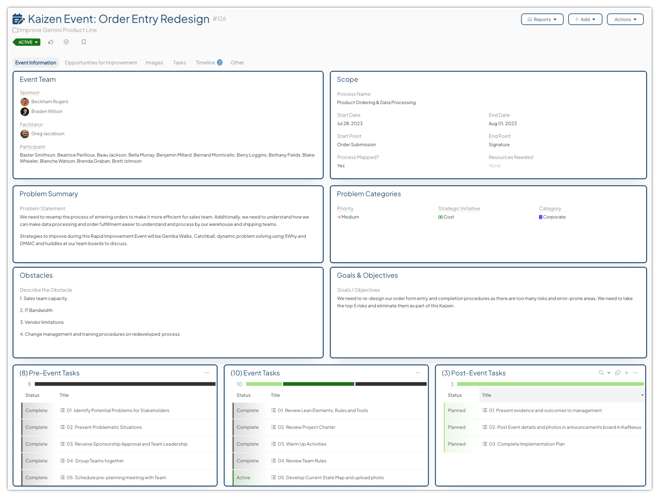
KaiNexus provides the infrastructure for the full event lifecycle. Before the event, the charter, scope, team assignments, baseline metrics, and supporting documents live in one place -- no shared drives, no email chains. During the event, teams log observations, track tasks on kanban boards, and document root cause analysis in real time. Nothing gets lost on a whiteboard that gets erased.
After the event is where KaiNexus matters most. Follow-up tasks stay visible and assigned. Leaders can see whether new standard work is being followed. Impact is measured over weeks and months, not just on the last day. And across every event the organization runs, KaiNexus aggregates the cumulative results -- so leadership can see the collective impact of the Kaizen event program, not just individual wins.
See how KaiNexus supports Kaizen events or talk to our team.

Frequently Asked Questions About Kaizen Events
How long should these things take?
Most teams find 3-5 days works best. Shorter events don't allow enough time to understand the problem thoroughly. Longer events lose focus and momentum. Match the duration to complexity -- a straightforward process issue may need three days, while a cross-functional challenge with multiple stakeholders typically needs five.
How many people should be involved?
Keep it to 6-8 people. You need the process owner, an executive sponsor, a facilitator, and people who actually do the work. Add a subject matter expert or internal customer if needed. Larger teams slow decision-making; smaller teams miss perspectives.
Can you do this remotely?
Yes. Remote Kaizen events work well with strong facilitation, a shared digital platform for capturing observations and tasks, and a commitment from every participant to focus full-time -- not multitask. The key constraint is engagement, not location.
What's the difference between this and just improving things day-to-day?
Daily Kaizen involves small, ongoing changes individuals make as part of regular work. Kaizen events pull a cross-functional team off their regular responsibilities for 3-5 days to tackle a bigger problem that daily improvement hasn't solved. Effective organizations practice both.
How do you know if it was worth it?
Compare post-event metrics to the baseline you established before the event started. Common measures include cycle time, defect rates, cost, and wait times. The most important check happens 30-90 days later: did the gains hold, or did the process drift back?
What if it doesn't work?
Not every event hits its targets. Diagnose what got in the way: was the scope too broad, the team missing key perspectives, the problem too complex for a 3-5 day sprint? Document what you learned and apply it to the next event. A failed event that produces organizational learning isn't wasted.



.svg)



Add a Comment